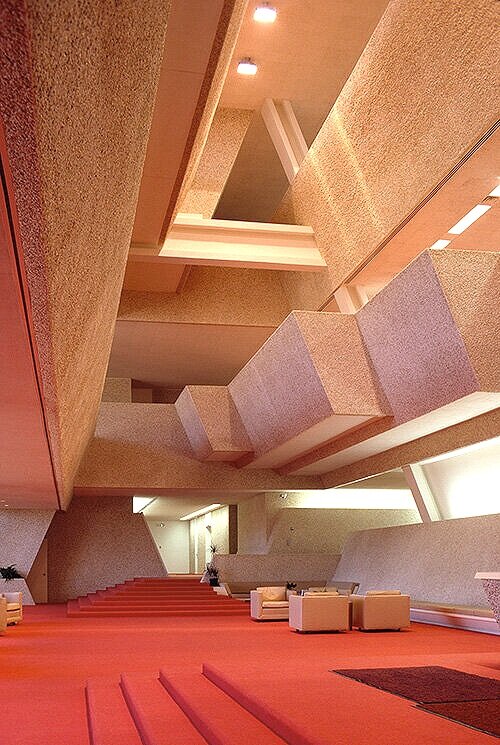
Burroughs Wellcome: Let the Historians Speak!

Photograph courtesy of © PJ McDonnell, The Paul Rudolph Heritage Foundation Archives

Photograph courtesy of © PJ McDonnell, The Paul Rudolph Heritage Foundation Archives

GREAT BUILDINGS: FROM BIOGRAPHY -TO- HISTORY

In our first earlier posts about the Burroughs Wellcome Building, we’ve looked at it from multiple viewpoints: its most significant features, its overall history, its use in Film and Television, and as an example of the creative process in architecture (from concept-to-details).

Buildings have biographies—just like people—and those articles could be said to be primarily “biographical”. But, just like any a person’s life story, a building is also subject to assessment—the judgement of discerning historians, as well as it’s occupants, visitors, critics, and journalists. This process starts from the time the design is unveiled, and continues through the years of its existence and memory.

Here, we’ll let several architectural historians speak: offering their insights into the building’s design, physical presence, spatial-sensual qualities, and its relation to the users’ needs and experiences.

better+tony+monk+cover.jpg

THE ART AND ARCHITECTURE OF PAUL RUDOLPH

By Tony Monk

“Stretching expansively across a wooded hillside ridge in North Carolina, this large corporate headquarters and laboratory complex for the intranational Burroughs Wellcome company typified Paul Rudolph’s dramatically sculptural style. In response the the client’s need for a distinctive image to represent the company’s performance, Rudolph designed a building which was intended to be a forceful extension of the hillside itself. Inside he created a spatial and structural solution that was uniquely original and possessed ultra-modern space-age characteristics.”

“The most dramatic feature of this design was the all-pervading characteristics that were created by the sharply angular slopes to the walls and columns. Surprisingly these were built at 22-1/2 degrees to the vertical, a device which Rudolph said echoed step inclines of the hills around the site. These interesting geometric forms were repeated extensively around the building—in windows angled downward, in the sloping seats and solid balustrades. Even the cupboards and service doors in the corridors . . . . were all built at this very steep angle.”

“A decade after this development was completed (in 1972), Paul Rudolph as asked to extend the premises to incorporate medical offices and a large dining room for the staff. He continued the theme of the angled supports, but this time used V-shaped twin columns, which created a crystalline rhythm throughout the extension. The sizeable restaurant was generally single-storey around the perimeter but then rose up dramatically to five storeys in the middle to provide roof lighting at the center with various mezzanine levels skirting this interesting space.”

“Together, the soaring internal areas, punctuated by the balconied walkways, and multi-level offices, pierced with unexpected floods of light, all contribute to make this one of Paul Rudolph’s best works.”

“The headquarters is both a credit to and a reward for the enlightened client who commissioned and then recommissioned Paul Rudolph to design this amazingly original modern building. . . .” — excerpted from: The Art and Architecture of Paul Rudolph, by Tony Monk, West Sussex, Wiley-Academy, 1999

colorful%2Bde%2Balba%2Bcover.jpg

PAUL RUDOLPH: THE LATE WORK

by Roberto de Alba

The “new wing” of the Burroughs Wellcome building (with V-shaped frames), referred to by historian Roberto de Alba. Image © the estate of Paul Rudolph, The Paul Rudolph Heritage Foundation

The “new wing” of the Burroughs Wellcome building (with V-shaped frames), referred to by historian Roberto de Alba. Image © the estate of Paul Rudolph, The Paul Rudolph Heritage Foundation

“…Rudolph devised an elongated hexagonal module that gives the building a strong horizontal reading on the long elevations. The module reveals its hexagonal geometry in the short elevations., pulling out of the building in interesting ways to express its ability to expand.”

“The interior spaces are a direct by-product of the diagonal structural geometry and are simply stunning. The entry lobby is a thing of the future. The space soars, exposing three levels of balconies, which maintain the diagonal lines of the A-frame. The lab spaces are unusual in their high ceilings and natural illumination (by skylights). It is not surprising that the futuristic interiors of the building were the setting for the movie Brainstorm.”

“The new wing adopts some of the themes of the original building, transforming them in interesting ways. The hexagonal module reappears in the long elevation, reinforcing the linearity of the wing. The A-frame of the original turns into a V that is exposed and repeated in parallel along the length of the wing.” — excerpts from: Paul Rudolph: The Late Work, by Roberto de Alba, New York, Princeton Architectural Press, 2003

The “ziggurat” character of the building, mentioned by Stimpson, is captured in this photograph. Image courtesy of Joseph W. Molitor architectural photographs. Located in Columbia University, Avery Architectural & Fine Arts Library, Department o…

The “ziggurat” character of the building, mentioned by Stimpson, is captured in this photograph. Image courtesy of Joseph W. Molitor architectural photographs. Located in Columbia University, Avery Architectural & Fine Arts Library, Department of Drawings & Archives

A FIELD GUDE TO LANDMARKS OF MODERN ARCHITECTURE IN THE UNITED STATES

by Miriam f. Stimpson

“A dynamic and expressive design was created for this administrative headquarters. Rhythm and space are achieved through the use of strong external forms arranged in a contemporary “ziggurat fashion.” Lighting within the interior spaces effectively adds to the building’s design. The interaction of bold forms with the rolling hillside is intriguing as well as harmonious. The building is one of its kind in the nation.” — adapted from: A Field Guide to Landmarks of Modern Architecture in the United States, by Miriam F. Stimpson, Englewood Cliffs, Prentice Hall, 1985

HABs+logo.jpg

HABS: THE HISTORIC AMERCAN BUILDINGS SURVEY

The Historic American Buildings Survey (HABS), founded in 1933, is part of the Historic Documentation Programs administered under the National Parks Service. HABS is charged with documenting America's architectural heritage. Their report on Burroughs Wellcome (Report No. NC-418), written by architectural historian Vyta Baselice, is currently the most comprehensive survey and assessment of of the complex.

The full report can be accessed here. It is well worth quoting extensively—and it is our pleasure to present a selection of excerpts from it:

“The Burroughs Wellcome Corporation Headquarters in Research Triangle Park, North Carolina was designed by Paul Rudolph starting in 1969 and completed by the Daniels Construction Company in 1972. Planned as an “M.I.T. of North Carolina” this area between Raleigh and Durham was developed starting in the 1950s as a center for high-tech corporate research to attract and keep a highly educated, white-collar population in a Jim Crow state. Research Triangle’s ability to lure the pharmaceuticals giant Burroughs Wellcome, a company with roots in nineteenth century England, away from their suburban New York headquarters solidified the area’s status as a significant economic center no longer merely on the regional, but now also on the national scale. The design and construction of the new Wellcome Headquarters building was a significant affair and was meant to make a statement regarding the company’s new modern image and illustrate the advanced state of laboratory research and pharmaceutical work in the Research Triangle. Paul Rudolph worked with the corporation to design facilities that would accommodate a wide range of functions. . . .”

“The building is notable for its futuristic design, frequently described as Brutalist, marked by an exposed concrete and aggregate exterior and slanted steel columns that intersect in V-shapes and give the structure its distinctive appearance.”

“The structural system employed in the building also showcases the architect’s interest in industrial construction methods and the use of prefabricated panels for exterior and interior partitions. Rudolph likewise experimented with the integration of novel materials and exterior treatments. . . .”

“In terms of interior design, the building offers expansive multi-story gathering spaces with spot lighting exposing the irregular structural system. Bright carpets that blended red, orange, and pink colors were installed in communal areas to add to the drama of the headquarters. Other spaces that received extensive attention include research laboratories with state of the art equipment and custom-fitted cabinetry. . . .”

“. . . . raised in the South, the architect had the ideal background to design a world-class building in North Carolina that was global and radical in its approach yet sensitive to local work and life patterns. In addition to his professional expertise and reputation, Rudolph brought excellent customer service. Burroughs Wellcome leadership noted the architect’s “bedside manner of a sympathetic physician” and his ability to “cushion us against the shock-waves of certain mundane realities that have a habit of looming larger and larger.”

“Despite the challenging construction process, Burroughs Wellcome was nonetheless completed in 1972 and applauded instantly for its bold appearance. The structure’s distinctive architectural character is most clearly visible at the entrance to the building. The façade is a playful arrangement of angular forms that appear to grow out of the core structure. While visually provocative, the façade fails to reveal its organizational logic. It instead suggests that the sculptural complex must serve an intrinsically futuristic and forward-thinking function whose true nature cannot be fully comprehended from the exterior. One therefore must enter the structure and learn about its activities in order to understand the architectural arrangement. In this way, Rudolph’s design contradicts the famous “form follows function” rule, first suggested by Louis Sullivan in the nineteenth century. The exterior’s formal gymnastics are accomplished through a careful arrangement of exposed structural members. Indeed, the bold white columns that sit at a 22.5-degree angle are particularly important in breaking up the building’s forceful horizontality. Other design elements, like the white window beams, repetition of the concrete panels, and even the flag pole, echo the slanted verticality of the structural columns and add to the productive tension of the design.”

“In addition to the structure, Rudolph’s careful selection of construction materials, which were limited primarily to metal, glass, and concrete, add to the building’s distinctive appearance. As discussed above, the metal superstructure, comprised of A-frames that are painted white, breaks up the building’s horizontality. Rudolph did not treat the building’s windows in a conventional manner – instead, they appear as entire surfaces that follow and accentuate the building’s shape. At times, they wrap around the structure, much like Le Corbusier’s ribbon windows at Villa le Lac. The glass is also tinted and the scale and positioning of the windows follows a rhythm established by the concrete panels. Finally, the precast concrete panels with a carefully selected medium-size grey tint gravel contribute most significantly to the design’s distinctive character. And the concrete mix is employed not only on the façade, but all throughout the building’s interior as well as some of the sidewalks that are immediately adjacent to the structure. Most notably the aggregate was also used for the reception desk.”

“Although the building is visually compelling, Rudolph’s interest in curating the visitor’s experience by playing with scale and volume is significant and typically understated, especially in photographic representations. However, this is an important aspect of the overall architectural experience, particularly the entrance, and reflects the influence that Frank Lloyd Wright had upon Rudolph’s work. Upon climbing up a set of concrete stairs up to the level of the structure (or by exiting one of the two executive carports), the visitor will encounter the large structural columns. The first columns and space encountered are distinctly smaller and compressed. As the visitor proceeds to the entrance, both the volumes and columns progressively increase in scale until the first major gathering space opens up to reveal the grand scale of the building. The third-floor balcony, which hovers over this front plaza, adds to the drama and spectacle of the design. Archival photographs reveal that the main plaza was used as an events space with seating arranged facing the glazed wall. The door to the building is notably missing from this grand space and instead is situated to the side out of sight, underneath a sizeable horizontal plane. “

“Upon entering the building, the visitor’s movement and experience are once again carefully curated in a familiar arrangement of volumes that progressively increase in size, finally revealing an impressive lobby whose height extends three levels. While undoubtedly striking, the lobby appears to be taller than it actually is due to Rudolph’s design of openings that employ the 22.5-degree angle and decrease progressively thus heightening the visitor’s sense of verticality. The lobby is an architecturally distinctive space, notably different in character from the exterior forms, that creates a cave-like environment. The laboratory wing of the structure contains a similarly open multi-level communal space.”

“Modernist architects often hoped that unusual architecture that challenged common work and living practices would encourage greater creativity and efficiency. Paul Rudolph and Burroughs Wellcome were not an exception. The design integrated some novel solutions for creating multi-purpose spaces. For example, the large auditorium located off the lobby had a mechanism that would have brought about partitions to bifurcate the large space into two for smaller viewing audiences. While actual creative output is difficult to measure, the company’s attitudes were clearly displayed in photographs of workers and their daily activities. For example, company photographs commonly featured the building as a framing device, which in one case took up more of the portrait than the workers themselves. Similarly, when advertising one of the company’s products, employees were shown interacting with the building in a creative way, climbing atop the different layered roofs and hanging out with their colleagues. Even when engaging in other types of work-unrelated leisurely activities, like participating in company-sponsored health programs or playing softball, workers could not avoid the presence of the distinctive structure. The building’s design therefore served as a tool to maintain company presence throughout the workers’ daily experiences.”

Pages from the HABS report on Burroughs Wellcome, like the one shown above, have intriguing illustrative material, generally not found outside of archives.

Pages from the HABS report on Burroughs Wellcome, like the one shown above, have intriguing illustrative material, generally not found outside of archives.

This page from the report includes a drawing produced by Rudolph’s office: a sketch showing how offices would be arranged along the building’s angled window walls.

This page from the report includes a drawing produced by Rudolph’s office: a sketch showing how offices would be arranged along the building’s angled window walls.

Heyer+american+architecture+cover.jpg

AMERICAN ARCHITECTURE: IDEAS AND IDEOLOGIES IN THE LATE TWENTIETH CENTURY

By Paul Heyer

“The dynamics of diagnonal, tapered space are further explored in the more complex program for the corporate headquarters of Burroughs Wellcome. Here, within the diagonal movement of interior space, Rudolph says that “growth and change is implicit in the concept. It is the idea of a building never finished where one can pull out parts.” Architecturally it is a delineated and tightly resolved attitude that, in spirit at least, somewhat parallels that of [John] Johansen’s more “as built,” loosely conceived and less seemingly-manipulated and open-ended approach. The building’s diagonal volume is an upward extension of the crest of a ridge on which it is built. The set back floors allow for a continuous system of skylights at each floor to pull light deep into interior spaces while enabling ceiling heights to be raised to fifteen feet at the building’s exterior edges, increasing the sense of space in movement with the interiors. As the linear planes of the building are bunched in an end expression of solid, shifting, tubelike elements, they visually evoke the idea of modular elements, although in fact they are the product of conventional steel frame construction. The groping and combining of modular elements as and expression of a technological capability, a sound idea if one not so economically possible in reality, is a notion that continues to preoccupy Rudolph and in many ways give impetus to the shifting planes that impinge upon rather than elementally define space.” — excepted from: American Architecture: Ideas and Ideologies in the Late Twentieth Century, by Paul Heyer, New York, Van Nostrand Reinhold, 1993

NORMAN FOSTER

Finally, since Rudolph’s drawings for the Burroughs Wellcome building are so compelling, here is a quote from Norman Foster. He has the advantage of a long perspective on Paul Rudolph—an historical viewpoint—going all-the-way back to the time when he had been a student and employee of Rudolph’s, while studying at Yale.

“Many of the these drawings, especially the perspective sections, would encapsulate in a single image the range of Rudolph’s concerns as an architect. There was his quest to define and model space with light and planar surfaces; his interest in climate and the relationship between structure and services; his exploration into modularity and the potential of prefabrication—a later interest in high density urban mega-structures.” — Norman Foster, from the foreword to: The Art and Architecture of Paul Rudolph, by Tony Monk, West Sussex, Wiley-Academy, 1999

Rudolph’s perspective-section drawing through the body of the building (with its famous entry lobby), indicating the dynamic spaces within. Image © the estate of Paul Rudolph, The Paul Rudolph Heritage Foundation

Rudolph’s perspective-section drawing through the body of the building (with its famous entry lobby), indicating the dynamic spaces within. Image © the estate of Paul Rudolph, The Paul Rudolph Heritage Foundation

YOU CAN HELP SAVE BURROUGHS WELLCOME !

Burroughs Wellcome’s loss would be a disaster—a titanic waste of our nation’s cultural heritage.

When a great building is destroyed, there are no second chances.

NOW, THERE ARE TWO THINGS YOU CAN DO:

  • Sign the petition to save Burroughs Wellcome. You can sign it here.

  • We’ll send you bulletins about the latest developments. To get them, please join our foundation’s mailing list: you’ll get all the updates, (as well as other Rudolphian news.)—you can sign up at the bottom of this page.

A good example of the powerful drawings, in which Rudolph explored and conveyed his vision—as spoken of in Norman Foster’s quote above. This is his perspective rendering of the dining area (about which historian Tony Monk wrote)—a dynamic space whic…

A good example of the powerful drawings, in which Rudolph explored and conveyed his vision—as spoken of in Norman Foster’s quote above. This is his perspective rendering of the dining area (about which historian Tony Monk wrote)—a dynamic space which was constructed as part of the 1976 extension. That addition has been demolished, and now the main part of the building is under threat too. Image © the estate of Paul Rudolph, The Paul Rudolph Heritage Foundation

Rudolph at Burroughs Wellcome: Concept, Development, and the Caring Details

The Burroughs Wellcome was designed for growth—and this is a section drawing study by Paul Rudolph, for an extension to the building. Such a colorful drawing might look exuberantly and boldly “arty” (as though the architect had only a nebulous relat…

The Burroughs Wellcome was designed for growth—and this is a section drawing study by Paul Rudolph, for an extension to the building. Such a colorful drawing might look exuberantly and boldly “arty” (as though the architect had only a nebulous relation to practicalities)—but a close inspection shows that, while Rudolph was developing the overall concept, he was simultaneously paying close attention to dimensions, adjacencies, floor heights, and the locations of different functions. This kind of drawing—seemingly florid, but layered with distilled, practical information—is typical of the kind of study drawings which Paul Rudolph did at the beginning of his design process. © The Estate of Paul Rudolph, The Paul Rudolph Heritage Foundation.

"We Must Understand That After All The Building Committees, The Conflicting Interests, The Budget Considerations, And The Limitations Of His Fellow Man Have Been Taken Into Consideration, The Architect’s Responsibility Has Just Begun. He Must Understand That Exhilarating, Awesome Moment.

When He Takes Pencil In Hand, And Holds It Poised Above A White Sheet Of Paper, He Has Suspended There All That Has Gone Before And All That Will Ever Be." 

—Paul Rudolph

ARCHITECTURAL DESIGN: THE MYSTERY

In looking at Burroughs Wellcome—one of Paul Rudolph’s best (and best loved) creations—one naturally wonders: How did such a design come to be? With a prolific architect like Rudolph, whose creativity took him along so many different paths, that’s a compelling inquiry.

“How does the magic happen?” That’s one way of putting one of the most fascinating questions about the creation of architecture—for it’s indeed a wonder how one gets all-the-way from a client’s request to a tangible, solid, building that’s ready-for-occupancy.

The least mysterious phase happens at the end of the process: once a “construction set” of drawings (sometimes called “working drawings” or the “contract set”) has been drawn-up by he architect and issued to the general contractor, the process of construction is fairly well understood. [Although, as anyone who’s ever been involved in building project can tell you, it is also fraught with possible pitfalls, detours, and surprises.]

But perhaps it would be useful to return to the beginning of the process….

ARCHITECTURAL DESIGN: THE PROGRAM

Initially, the architect receives requests and information from the client: the “program”. Sometimes this is nebulously articulated—or conversely, sometimes the client’s needs are enumerated in intimidatingly calibrated detail. Rudolph wrote urgently about the need to get, early on, as much info as possible:

“Always, always, always, everything, everything, everything at the beginning. I'm a great believer in the big bang. You cannot isolate parts, ever. That's the reason why it's so important to know as much detail as possible at the very beginning.”

“I'm just saying that for me it's a matter of getting your fingers on what you can and cannot do from a legal viewpoint . . . . You have to know what's possible. Architecture is not a question of the purely theoretical if you're interested in building buildings. It's the art of what is possible.”

A sketch by Paul Rudolph, in which he’s working out the design of a hallway within Burroughs Wellcome. This sort of drawing shows another aspect of the architect’s working method: the section is sketched adjacent to the plan, and at the same scale (…

A sketch by Paul Rudolph, in which he’s working out the design of a hallway within Burroughs Wellcome. This sort of drawing shows another aspect of the architect’s working method: the section is sketched adjacent to the plan, and at the same scale (so that both can be well coordinated). At top right one can clearly see part of the plan layout, including rooms and what appear to be laboratory benches. © The Estate of Paul Rudolph, The Paul Rudolph Heritage Foundation.

At Burroughs Wellcome—which functioned as not only a corporate headquarters, but as also an active pharmaceutical research center with extensive laboratories and testing facilitates (where Nobel Prize winning work was conducted!)—Rudolph would have received a careful listing of the functions that the 300,000 square foot building had to accommodate, including the approximate sq. ft. area needed for each. Sometimes programs also indicate significant “adjacencies” (what specific spaces need to be nearby each other).

Just as important (as the above “material” needs) are the intangible ones: what the project means to the client, and what it will communicate. Significance and symbolism: they’re as much part of the program as the list of required rooms. It’s not always easy to determine this, and clients are generally not used to articulating such matters. As Rudolph states, it’s important to find out..

“…what it is the owner truly wants to do— but he doesn't necessarily tell you, you have to read between the lines— and what should be done ideally.”

ARCHITECTURAL DESIGN: THE GRAND SYNTHESIS

It is at this point that the mystery truly begins. The architect creates an overall concept for the building’s organization: the “parti”—and with it will be the architect’s most central decisions about the building’s placement on the site, the organization of the plan, and the shaping of spaces and volumes—along with concepts about which structural system and what materials are to be used.

Looking over the architect’s shoulder—in the process of creation? Here Paul Rudolph is photographed working at his drawing board in his New Haven office, with members of his staff in the background.

Looking over the architect’s shoulder—in the process of creation? Here Paul Rudolph is photographed working at his drawing board in his New Haven office, with members of his staff in the background.

How this happens—the very process of creation—is one of the great human questions, whether it be examined in the context of painting, music, literature, or architecture. Some architects refuse even to talk about it, claiming it’s a very intimate matter (and likely, one they don’t even quite understand themselves.) Some are prolix in their explanations, offering either theoretical, meat-and-potatoes, or poetic rationales for what they do. At the other end of the spectrum are “functionalist” architects like Hannes Meyer (who, for several years, was director of the Bauhaus): he claimed that arriving at design solutions was like solving an a mathematical problem, and he offered a stark equation: Function x Economy = Architecture. Rudolph repudiated such such an extreme position, saying:

All I'm really saying is that the most rational architect in the world is not to be trusted at all because there is no such thing as true rationalism when you are speaking of architecture.

Rudolph himself acknowledged the mystery of the phenomena of creation:

“In terms of how one goes about designing anything, you don't really know, or at least I don't know, until after the fact. There are so many elements that come into play that if you wait to figure out what it is you truly want to do once you have a project to work on there won't be enough time. You have to, as I see it, have a reservoir of things that you feel should be done and then you draw on that reservoir and hopefully apply elements from that reservoir in an intelligent fashion. . . . . You can have one hundred reasons why you do things after the fact.”

“I can say that in spite of all the rationalizations that architects go through, including myself, you can pay no attention to what architects say, you can only pay attention to what they do.”

Because architecture must deal with very practical issues—from space needs -to- the structural capacity of steel—the truth about the nature of architectural creation would necessarily be a merging of the functional and the artistic ways of solving problems. Beyond that, the essential nature of the “synthetic leap” is conjectural (though the topic of design creativity has been an area of ongoing serious research.)

ARCHITECTURAL DESIGN: DEVELOPMENT

Burroughs Wellcome allows us to see another aspect of architectural creation: “design development.”

Architects use “development” in a different sense than is used in the real estate field. Architecturally, it means taking the designer’s original conception of the building and working out the particulars.

A section sketch drawing, by Paul Rudolph, showing him in the process of designing the canopy for the main entrance to the Burroughs Wellcome building. A good example of design development, the drawing shows how Rudolph was working out his idea abou…

A section sketch drawing, by Paul Rudolph, showing him in the process of designing the canopy for the main entrance to the Burroughs Wellcome building. A good example of design development, the drawing shows how Rudolph was working out his idea about the shaping of the space and volumes—yet simultaneously thinking through the structure (steel beams and possibly steel joists are shown), scale (his placement of figures), choice of materials, and key dimensions. His use of color, to indicate different materials and planes, is part of the language of architectural drawing which extends back to the 18th century. © The Estate of Paul Rudolph, The Paul Rudolph Heritage Foundation.

For example: it’s not enough that the architect might have started out by envisioning a lobby with cantilevered balconies, supported by a steel structure. In the design development phase, the exact heights, projection, angles, and materials of those balconies would begin to be thought through (including their relationship to the building’s structure.)

Below is Rudolph’s perspective- section rendering through the Burroughs Wellcome building and site:

Paul Rudolph’s perspective-section rendering through Burroughs Wellcome, cutting though the main entry lobby, and showing the building’s relation to the site. © The Estate of Paul Rudolph, The Paul Rudolph Heritage Foundation.

Paul Rudolph’s perspective-section rendering through Burroughs Wellcome, cutting though the main entry lobby, and showing the building’s relation to the site. © The Estate of Paul Rudolph, The Paul Rudolph Heritage Foundation.

In the middle of it, he shows one of the building’s most famous features— it’s entry lobby:

Enlargement of a portion of Paul Rudolph’s perspective-section through the Burroughs Wellcome building, focusing in on the main entry lobby. © The Estate of Paul Rudolph, The Paul Rudolph Heritage Foundation.

Enlargement of a portion of Paul Rudolph’s perspective-section through the Burroughs Wellcome building, focusing in on the main entry lobby. © The Estate of Paul Rudolph, The Paul Rudolph Heritage Foundation.

Clearly, he already—even at this stage—has a thorough conception the layout and features of this lobby. In this rendering one can see important features, including: the stepped volumes at the right side of of the second floor’s balcony, the steps and platforms in the foreground and in the distance, the beam crossing from one side of the third floor’s balcony to the other, and the angled columns.

And in the actual, built space—

Burroughs Wellcome’s main entry lobby. Image courtesy of the Massachusetts Institute of Technology, photograph by G. E. Kidder Smith

Burroughs Wellcome’s main entry lobby. Image courtesy of the Massachusetts Institute of Technology, photograph by G. E. Kidder Smith

—these aspects of the design were almost exactly carried out.

Enlarging a portion of that section-perspective rendering reveals that Rudolph was already thinking about the structural aspects of the building—and not just the diagonal columns. Below you can see that the section cuts through steel beams—and, allowing for perspective, that steel-work would have framed directly into the diagonal vertical structure.

Close-up of Paul Rudolph’s perspective-section through the Burroughs Wellcome building, here focusing in on the main lobby’s third floor balconies. © The Estate of Paul Rudolph, The Paul Rudolph Heritage Foundation

Close-up of Paul Rudolph’s perspective-section through the Burroughs Wellcome building, here focusing in on the main lobby’s third floor balconies. © The Estate of Paul Rudolph, The Paul Rudolph Heritage Foundation

One might imagine that, for an architect of Rudolph’s vast experience, inclusion of such structural elements in a rendering (and placing them in the right locations) would be almost intuitive. Perhaps—so for a clearer example of development, let’s look at what happens when the Burroughs Wellcome building section needs to move in the direction of constructable drawings.

Close-up of Paul Rudolph’s perspective-section rendering of Burroughs Wellcome, focusing on the main body of the building and its entry lobby. © The Estate of Paul Rudolph, The Paul Rudolph Heritage Foundation

Close-up of Paul Rudolph’s perspective-section rendering of Burroughs Wellcome, focusing on the main body of the building and its entry lobby. © The Estate of Paul Rudolph, The Paul Rudolph Heritage Foundation

Above is an enlargement of the main body of the building’s section-perspective. It’s beautiful to look at, and Rudolph’s legendary skill as a perspectivist pulls us in, fascinated by the forms he’s chosen and the rich ways he’s depicted them.

But this is where design development begins: those forms and spaces need to be exactly defined and dimensioned, materials need to be specified, and the relationship of all the parts needs to be coordinated with precision (including with the structural system). Below is the a drawing, from Rudolph’s office, which does this: it’s filled with notes, dimensions, and shows the relationship of the section to adjacent parts of the building which are beyond. This development will then lead to more drawings—which contain even more construction information (including final details)

Section drawing, through main entrance, of the Burroughs Wellcome building. © The Estate of Paul Rudolph, The Paul Rudolph Heritage Foundation.

Section drawing, through main entrance, of the Burroughs Wellcome building. © The Estate of Paul Rudolph, The Paul Rudolph Heritage Foundation.

ARCHITECTURAL DESIGN: CARE IN THE DETAILS

When someone refers to “details,” they are usually peaking of the smallest (or least important) aspects of a project or situation—and the use of the term is often dismissive. But in architecture, the opposite is true: the “details” are intensely important. When architects say “details,” they mean the particular ways that the parts (and assemblies of parts) and materials of a building are selected, shaped, located, and connected together.

Rudolph’s attention to the detail was comprehensive, and even extended to the drainage channels (which he used to form striking angled lines on the building’s exterior), aligning them with the window divisions (“muntins”) and designing a ground-leve…

Rudolph’s attention to the detail was comprehensive, and even extended to the drainage channels (which he used to form striking angled lines on the building’s exterior), aligning them with the window divisions (“muntins”) and designing a ground-level concrete element (“splash block”) that further carried out the linear theme. Photograph © PJ McDonnell, The Paul Rudolph Heritage Foundation Archives

This can extend to from things that occupants would hardly ever notice (like how waterproofing materials are positioned), to things they directly see and engage with daily (like the design of railings, elevator buttons, and even the choice of typeface for the building address numbers.) These visual elements may, in themselves, be small—-but cumulatively they convey a sense that the building was designed with thoroughness and unflagging attention. It shows that the architect cared, and that each decision (whether it be about the shape of a stair nosing or the tint of the windows) is consistent with an overall vision for the building. [And if such care is not exercised, even a new building can convey a sense of disheartening sloppiness.]

Rudolph cared.

He learned this not only from his teachers, like Gropius (the drawings for whose projects are detailed with surprising care), but also from the beginning of his practice, when he had to become inventive with inexpensive materials in order to work within modest construction budgets. And of course, Mies van der Rohe—one of the titans of Modernism—had a famous saying that all architects knew well: “God is in the details.”

A building’s construction set, which includes drawings of all the details, occupies a large part of an architect’s (and their staff’s) attention. This can mean generating dozens (and for some very complex buildings: hundreds) of drawings. It’s a challenge to maintain the architect’s original “vision” of the building, so that it does not get distorted or diluted in the course of creating the construction documents from which it will be built.

A CASE STUDY: DETAILS AT BURROUGHS WELLCOME

At Burroughs Welcome, we can follow an example of the care which Rudolph and his team brought to the details.

Below-left is reproduced the right side of Rudolph’s perspective-section through Burroughs Wellcome. In it we can see that the edges of the floors typically terminate in a set of continuous architectural elements: a band of angled windows, a band of angled skylights, and a band of angled portions of the exterior wall.

Below-right is an enlargement of the uppermost example of that floor-window-wall-skylight assembly. The architect, in doing the construction drawings, will be concerned about each juncture:

  • Where the top of the skylight meets the building (in this case: there’s a small upright, at the end of the floor, at the top of the skylight—possibly forming a rainwater drainage channel.)

  • The bottom of the skylight, where it meets the top of the angled wall.

  • The bottom of the angled wall, where it meets the top of the angled window.

  • The bottom of the window, where it meets the angled skylight of the next floor down.

window+side+section.jpg
Left: a portion of Rudolph’s section-perspective, showing the the right side of the building. Above: an enlargement of one of the assemblies at the edge of the uppermost floor. It includes the angled skylight, angled exterior wall, and angled window…

Left: a portion of Rudolph’s section-perspective, showing the the right side of the building. Above: an enlargement of one of the assemblies at the edge of the uppermost floor. It includes the angled skylight, angled exterior wall, and angled window. Both drawings © The Estate of Paul Rudolph, The Paul Rudolph Heritage Foundation.

Exactly how each one of these adjacencies (architects’ term for them is: “conditions”) is to be detailed is one of the great challenges of an architect’s practice—especially if they care that the details are consistent with (and supportive of) their original vision for the building.

In working out the details, an architect will not only be conscious of their general concept for the building, but they will simultaneously be focused on a large number of practical questions, such as:

  • Can these conditions be made waterproof?

  • Is there sufficient thermal insulation?

  • Are the proposed materials available?

  • Will building this assembly fit within the construction budget?

  • Can the proposed arrangement be built by available construction methods?

  • Does the proposed design allow for regular maintenance to be performed?

  • If something needs replacement(like a window pane), can it be easily repaired?

  • Will the materials age well?

And—-

  • If any of the above presents a problem, what alternatives can be devised (which will not violate the architect’s overall conception for the building)?

Below is one sheet from the extensive set of construction drawings that Rudolph and his office prepared for the Burroughs Wellcome building—and it shows the very assembly we’ve been considering!

Detail of inclined window and skylight section and construction details, from the set of construction drawings prepared by Paul Rudolph and his office for the Burroughs Wellcome building. © The Estate of Paul Rudolph, The Paul Rudolph Heritage Found…

Detail of inclined window and skylight section and construction details, from the set of construction drawings prepared by Paul Rudolph and his office for the Burroughs Wellcome building. © The Estate of Paul Rudolph, The Paul Rudolph Heritage Foundation

Below is an enlargement of the right side of that drawing. It goes into great detail about all of the adjacencies (from top-to-bottom: roof to skylight; skylight to wall; wall to window, and window to skylight.) Materials, dimensions, connections, required features, and relationships to other parts of the building are noted with thoroughness.

But even that is not sufficient. To get the building built—in the way the architect envisioned it—even more information needs to be provided to the contractor.

An enlargement of a portion of the above drawing, focusing on the inclined window and skylight. The circled area indicates the areas of the assembly where the glazing meets the building’s walls—and those adjacencies are worked-out in great detail be…

An enlargement of a portion of the above drawing, focusing on the inclined window and skylight. The circled area indicates the areas of the assembly where the glazing meets the building’s walls—and those adjacencies are worked-out in great detail below, in a sheet from the same set set of construction drawings.© The Estate of Paul Rudolph, The Paul Rudolph Heritage Foundation

The great English architect, Sir Edwin Lutyens, said construction drawings were like “a writing letter to the builder” telling him what to do. For Burroughs Wellcome, even more detail had to be put into Rudolph’s “letter” to the contractor—and within the the area we’ve circled (above) are three conditions that needed to be magnified further, in order to really show how they’re to be built.

Below is the drawing which resulted—another sheet in the construction set. These details are drawn-full size, and show precisely the shapes, configurations, materials, and dimensions of every component—metalwork, structure, glass, waterproofing, drainage channel, glazing gaskets, connectors, and even an anchor for the window washer—needed to make the assembly buildable, and practical for ongoing life of he building.

Inclined window and skylight construction details, from the set of constuction drawings prepared by Paul Rudolph and his office for the Burroughs Wellcome building. © The Estate of Paul Rudolph, The Paul Rudolph Heritage Foundation.

Inclined window and skylight construction details, from the set of constuction drawings prepared by Paul Rudolph and his office for the Burroughs Wellcome building. © The Estate of Paul Rudolph, The Paul Rudolph Heritage Foundation.

Rudolph himself recognized the challenge of doing thorough construction drawings (including the detailing)—and the consequences if the challenge is not met and the vision is lost:

“Architecture is a personal effort, and the fewer people coming between you and your work the better. … This is a very real problem, and you can only stretch one man so far. The heart can fall right out of a building during the production of working drawings, and sometimes you would not even recognize your own building unless you followed it through.”

All that work, all that thinking, all that time—just to get the details right.

Easy? No. Important? Supremely! Did Rudolph do it? Absolutely!

SAVE BURROUGHS WELLCOME !

Losing Burroughs Wellcome would be a cultural disaster—a titanic loss to our country’s cultural heritage.

When a great building is destroyed, there are no second chances.

FOR NOW, THERE ARE TWO THINGS YOU CAN DO:

  • Sign the petition to save Burroughs Wellcome. You can sign it here.

  • We’ll send you bulletins about the latest developments. To get them, please join our foundation’s mailing list: you’ll get all the updates, (as well as other Rudolphian news.)—you can sign up at the bottom of this page.

Models were also part of Rudolph’s design process. This would be a “presentation model”—shown to the client for their final approval, as well as for the corporate leadership to use to communicate about the project to stakeholders and the public. But…

Models were also part of Rudolph’s design process. This would be a “presentation model”—shown to the client for their final approval, as well as for the corporate leadership to use to communicate about the project to stakeholders and the public. But “alumni”—former staff members of his office—have also told us that Rudolph also used models to develop his designs. © The Estate of Paul Rudolph, The Paul Rudolph Heritage Foundation.

Burroughs Wellcome was a pharmaceutical company, whose corporate symbol was a unicorn. In Rudolph’s model of the building (at left), he proposed a large unicorn sculpture as part of the main entrance plaza. It did not work out to include that sculpt…

Burroughs Wellcome was a pharmaceutical company, whose corporate symbol was a unicorn. In Rudolph’s model of the building (at left), he proposed a large unicorn sculpture as part of the main entrance plaza. It did not work out to include that sculpture—so Rudolph developed and distilled the idea. What he came up with (and got built) is a prominent flagpole, angled and pointed to evoke a unicorn’s horn—a brilliant feature and detail.

Burroughs Wellcome is a STAR ! — in film and television.

Paul Rudolph’s Burroughs Wellcome building, in North Carolina’s Research Triangle Park, was the prime location for the 1983 film, Brainstorm. Scenes were shot inside, outside, and on the grounds of the building. This candid snapshot, made between “t…

Paul Rudolph’s Burroughs Wellcome building, in North Carolina’s Research Triangle Park, was the prime location for the 1983 film, Brainstorm. Scenes were shot inside, outside, and on the grounds of the building. This candid snapshot, made between “takes”, shows a warning sign temporarily placed within the set of the villain’s office.

FROM STARCHITECTS -TO- STARRING BUILDINGS

Some architects’ work has “that something extra”—that star quality which gets their buildings to be selected as sets for films and television series. Set designers, like the legendary Ken Adam (famous for his work on Dr. Strangelove and the James Bond films) can create miracles—but directors and designers also welcome using actual, existing buildings & interiors as sets, and actively seek out interesting venues.

Buildings by Frank Lloyd Wright and John Lautner, are “a natural” for this, as their richly sculpted & textured works provide backgrounds that are already saturated with visual interest. Wright’s Ennis House (1924) may solidly sit in the Los Feliz neighborhood of Los Angeles—but that hasn’t stopped directors from using it (or creating sets inspired by it) for many productions—including: Blade Runner, Game of Thrones, Star Trek, Day of the Locust, Twin Peaks, and even South Park.

If you search for “Ennis House” and film in Google Images, one will get numerous hits. This example—an screen shot of part of a results page—shows that stills from Game of Thrones (upper left) and Blade Runner (lower left) readily come up. Both of t…

If you search for “Ennis House” and film in Google Images, one will get numerous hits. This example—an screen shot of part of a results page—shows that stills from Game of Thrones (upper left) and Blade Runner (lower left) readily come up. Both of them are said to have been inspired by the Ennis house. The other views show the Wright designed interior and exterior of the actual house.

Ken Adam chose John Lautner’s Elrod House as a set for the James Bond film, Diamonds Are Forever—and several other Lautner houses have been used in major films, including in The Big Lebowski and Iron Man.

RUDOLPH ON tHE BIG SCREEN

Paul Rudolph’s work fits well with this, offering intriguing designs which would attract a director’s and production designer’s eye. His work has been used in a variety of films, from the frenetic fire drill scene in 2001’s The Royal Tenenbaums -to- 2019’s Motherless Brooklyn (a film in which one of Rudolph’s visionary renderings forms part of the set).

In Motherless Brooklyn, one of Paul Rudolph’s renderings for the LOMEX project can be seen in the background, during a scene set in Moses Randolph’s office. Below is a full view of Rudolph’s actual rendering for this urban design. Drawing © The Esta…

In Motherless Brooklyn, one of Paul Rudolph’s renderings for the LOMEX project can be seen in the background, during a scene set in Moses Randolph’s office. Below is a full view of Rudolph’s actual rendering for this urban design. Drawing © The Estate of Paul Rudolph, The Paul Rudolph Heritage Foundation.

full+actual+LOMEX+rendering.jpg
A Google Images search for the terms “Royal Tenenbaums” and “fire drill” gives results like shown in the above screen shot: an interior of Rudolph’s own penthouse residence in Manhattan (top left); and Rudolph’s penthouse’s used as a set in the film…

A Google Images search for the terms “Royal Tenenbaums” and “fire drill” gives results like shown in the above screen shot: an interior of Rudolph’s own penthouse residence in Manhattan (top left); and Rudolph’s penthouse’s used as a set in the film, with Ben Stiller conducting a home fire drill (lower left).

BURROUGHS WELLCOME GOES TO THE MOVIES

The Burroughs Wellcome building comes up in at least two major film productions:

At top: a rendering of a set for The Towering Inferno.At bottom: a still from the film, for the same scene. Paul Newman (his back is foreground left), in the role of the architect, is shown entering his office.Are we seeing a set design that was ins…

At top: a rendering of a set for The Towering Inferno.

At bottom: a still from the film, for the same scene. Paul Newman (his back is foreground left), in the role of the architect, is shown entering his office.

Are we seeing a set design that was inspired by Paul Rudolph’s work at Burroughs Wellcome?

THE TOWERING INFERNO

Although Burroughs Wellcome’s most famous “starring role” is in 1983’s Brainstorm (see below), it at least seems to have inspired a set in a film made nearly a decade earlier: 1974’s The Towering Inferno.

A lushly cast production, it included the talents of mega-stars Paul Newman, Steve McQueen, Faye Dunaway, William Holden, and Fred Astaire—as well as numerous other performers.. One of the main characters (played by Newman) is an architect—the designer of the tower which (no fault of his!) goes up in flames. His entrance scenes are the embodiment of a late-60s/early 70’s architect’s fantasy.

At top right is a set designer’s rendering of the architect’s office, and below is a view of the finished set. The forceful use of angled planes (at walls, windows, built-in furniture, and ceilings), emphatic volumes, stairs, and the bold use of color resonate with Paul Rudolph’s work at Burroughs Wellcome. Might Rudolph’s design have inspired the filmmakers?

BRAINSTORM

Brainstorm (1983) is a science fiction film with a stellar cast: Christopher Walken, Natalie Wood, Louise Fletcher, and Cliff Robertson. It had a distinguished director, Douglas Trumbull (who had made contributions to the visual and photographic effects of 2001: A Space Odyssey, Star Trek: The Motion Picture, Blade Runner, and Close Encounters of the Third Kind.)

The film focuses on a research team's efforts to perfect a device that can record the sensory experiences and emotional feelings of a subject (and can then replay them, so that another person can access that experience too). Part of the drama is that it includes a scheme, by the company's management, to apply the results of their research to military uses that may be criminal or of questionable ethics.

A director of Trumbull’s sensibilities—having worked on numerous futuristic-science oriented films—would naturally be drawn to the building and interior environments of Burroughs Wellcome.

The typical doorway arch of the Krell, an advanced alien civilization, as designed for the 1956 film, Forbidden Planet. Such angular geometries are a frequent motif in the work of science fiction film set designers.

The typical doorway arch of the Krell, an advanced alien civilization, as designed for the 1956 film, Forbidden Planet. Such angular geometries are a frequent motif in the work of science fiction film set designers.

One of the most striking aspects of the building—both of its exterior and interiors—is its comprehensive use of angles: walls, windows, structural elements, and even the flagpole are angled to follow the overall theme that Rudolph applied across the complex. This creates exciting settings, with striking views and unexpected forms.

Reliance on such geometries has a distinguished lineage in film design, as in this scene (shown at right) from the classic science fiction film, Forbidden Planet (1956). Here, a doorway built by an alien civilization is emphatically angular (and similar forms show up in Brainscan.)

Below are some some screen shots of the building, inside and out, as used in Brainscan:

Nighttime, the building is a formidable presence…

Nighttime, the building is a formidable presence…

… as it is during the day.

… as it is during the day.

The building’s famous entry lobby didn’t have to be extensively modified for the movie—it was already impressive.

The building’s famous entry lobby didn’t have to be extensively modified for the movie—it was already impressive.

Strong diagonals pervade the sets, both inside …

Strong diagonals pervade the sets, both inside …

… and on the outside.

… and on the outside.

Even in the laboratory—where key scenes occur—the angled structural geometry is prominent..

Even in the laboratory—where key scenes occur—the angled structural geometry is prominent..

Diagonal design extends to the executive suite …

Diagonal design extends to the executive suite …

… and even into the bathrooms.

… and even into the bathrooms.

And shows up as an angular fantasy within the film. Was this too inspired by Rudolph’s design for Burroughs Wellcome (as exemplified in one of the building’s hallways. at right)? Photo by Henry L. Kamphoefner

And shows up as an angular fantasy within the film. Was this too inspired by Rudolph’s design for Burroughs Wellcome (as exemplified in one of the building’s hallways. at right)? Photo by Henry L. Kamphoefner

BW+hallway.jpg

BURROUGHS WELLCOME ON TV

REVOLUTION

Revolution (2012-2014) was a science fiction TV series that, across 2 seasons and 42 episodes, took the viewer into a future where a massive blackout—at that point, lasting 15 years—has terminated the use of electrical power all across the planet. The series traces a search for for the blackout’s mysterious cause (and its possible cure), set against a complex scenario of conflicting personal relationships and political machinations.

The last two episodes of season 1 are set in and around a powerful tower—a place which may be key to understanding the blackout (and solving it). Much of the first season of the series was shot in the Carolinas, and Burroughs Wellcome—with its characteristic diagonals—was used used as the set for some of the tower’s interiors.

Below are several scenes, shot in Burroughs Wellcome, from the show:

Burroughs Wellcome’s entry lobby—one of the building’s most powerful features—is tapped by the director and designer for a dynamic interior set.

Burroughs Wellcome’s entry lobby—one of the building’s most powerful features—is tapped by the director and designer for a dynamic interior set.

The bunker office of the US Vice President may well be the very same location as used for the evil executive’s office in the film Brainscan.

The bunker office of the US Vice President may well be the very same location as used for the evil executive’s office in the film Brainscan.

S01E19A.jpg
These views (from the show) are of special note because they allow one to see the aggregate finish which Paul Rudolph developed for the building—and …

These views (from the show) are of special note because they allow one to see the aggregate finish which Paul Rudolph developed for the building—and …

… which he used not only for Burroughs Wellcome’s exteriors, but also for some of the building’s interiors (including lobbies and offices).

… which he used not only for Burroughs Wellcome’s exteriors, but also for some of the building’s interiors (including lobbies and offices).

SAVE THIS GREAT ARCHITECTURAL “STAR”

Losing Burroughs Wellcome would be a disaster—a titanic loss to our country’s cultural heritage.

When a great building is destroyed, there are no second chances.

FOR NOW, THERE ARE TWO THINGS YOU CAN DO:

  • Sign the petition to save Burroughs Wellcome. You can sign it here.

  • We’ll send you bulletins about the latest developments. To get them, please join our foundation’s mailing list: you’ll get all the updates, (as well as other Rudolphian news.)—and you can sign up at the bottom of this page.

Modular+BW.jpg

Rudolph was visionary—and it certainly makes sense that some of his built “visions”—like Burroughs Wellcome—would attract the eyes of directors, production designers, and location scouts. It can evoke a variety of impressions—from bright to somber—depending on lighting, point-of-view, time-of-day, weather, and season. While most people coming to Burroughs Wellcome recall it as a pleasant place to work or visit, Joseph Molitor was able to create an image of “Moody Futurism” in this photograph—an atmosphere sure to be of interest to the makers of films and television.

It would be great if Burroughs Wellcome was used for more film and television productions—and for that: it has to be saved.

Image courtesy of Joseph W. Molitor architectural photographs. Located in Columbia University, Avery Architectural & Fine Arts Library, Department of Drawings & Archives

Paul Rudolph's spectacular Burroughs Wellcome Headquarters — a History

Paul Rudolph’s Burroughs Wellcome headquarters & research center in Durham, N.C. Image courtesy of the Massachusetts Institute of Technology, photograph by G. E. Kidder Smith

Paul Rudolph’s Burroughs Wellcome headquarters & research center in Durham, N.C. Image courtesy of the Massachusetts Institute of Technology, photograph by G. E. Kidder Smith

Out of a half-century career of creative and prolific work, Rudolph’s Burroughs Wellcome headquarters & research center stands out as one of his finest works. We’re now fighting to save this magnificent example of the convergence of corporate & scientific vision and architectural talent—and we thought it would be useful to share an outline of it’s history, purpose, and features.

A SITE FOR GROWTH: THE RESEARCH TRIANGLE PARK

The Burroughs Wellcome building (shown circled here), at 3030 East Cornwallis Road, in Durham, N.C.’s Research Triangle Park. Only a portion of this celebrated research development is shown here, but even in this partial view, one can see some of Bu…

The Burroughs Wellcome building (shown circled here), at 3030 East Cornwallis Road, in Durham, N.C.’s Research Triangle Park. Only a portion of this celebrated research development is shown here, but even in this partial view, one can see some of Burroughs Wellcome’s distinguished neighbors—among them: IBM, Cree, Toshiba, RTI, the North Carolina Biotechnology Center, and the National Humanities Center. Image courtesy of Google Maps.

A closer aerial view of the Burroughs Wellcome complex. Shown here is its current state, after a Rudolph-designed addition to the building (that had been located to the lower-left) had been demolished by the current owner. Landscape features, design…

A closer aerial view of the Burroughs Wellcome complex. Shown here is its current state, after a Rudolph-designed addition to the building (that had been located to the lower-left) had been demolished by the current owner. Landscape features, designed by Rudolph, have also been removed from the site. Image courtesy of Google Maps.

41vyBafn%252BpL._SR600%252C315_PIWhiteStrip%252CBottomLeft%252C0%252C35_SCLZZZZZZZ_.jpg

Founded in 1959, Durham, North Carolina’s Research Triangle Park is one of the most prominent research developments in the US. This is where hundreds of distinguished firms and organizations located their headquarters and research centers—and it is here that Burroughs Wellcome placed their US headquarters and laboratories.

They chose Paul Rudolph as their architect, and the project commenced design work in his office in 1969, and was completed and dedicated in 1972.

Burroughs Wellcome was designed for growth: the initial, main body of the building, was followed by several additions—in 1976, 1978, and 1982—all designed by Rudolph. His work in 1982 also included a master plan for the overall site.

The story of Durham’s Research Triangle Park is comprehensively told in Brain Magnet: Research Triangle Park and the Idea of the Idea Economy by Alex Cummings, PhD—and this fascinating study includes coverage of the Burroughs Wellcome building.

THE BUILDING: ITS PURPOSE, HISTORY, AND FEATURES

  • In February 1969, pharmaceutical company Burroughs Wellcome purchases a little over 66 acres of rolling woodland in Durahm, North Carolina’s Research Triangle Park. The company is a subsidiary of The Wellcome Foundation Ltd., based in the UK.

  • The client requests of Paul Rudolph a design that will be shaped to its needs, yet remain architecturally distinctive.

Burroughs Wellcome’s symbol is a unicorn—and Rudolph wanted to have a statue of a unicorn at the building’’s entry (it’s even shown on his architectural model for the building). When it did not work out to do include the statue, Rudolph came up with…

Burroughs Wellcome’s symbol is a unicorn—and Rudolph wanted to have a statue of a unicorn at the building’’s entry (it’s even shown on his architectural model for the building). When it did not work out to do include the statue, Rudolph came up with a creative alternative: a flagpole that would evoke the Burroughs Wellcome symbol, by being angled to match the unicorn’s horn.

  • Flexibility is a primary goal: each major area in Rudolph’s plan—laboratories, administration, and support services—are capable of being expanded by linear addition. To allow for this, Rudolph leaves the expansible ends of the building expressed as a pattern of flattened hexagons, so that the elements can be extended horizontally without disturbing the building’s visual order.

  • The building program includes 312,303 square feet of research laboratory and administrative space, including: 140 labs, a library, auditorium, cafeteria, and support activity spaces for 400 workers.

  • In plan, the building forms a giant “S”, with opposing arms that form a main entry court and a large service yard. Reception, cafeteria, library, auditorium, and administrative offices flank the entry court. Laboratories, research offices, and testing facilities surround the service yard.

  • The building exterior (and parts of the interior) is finished with a limestone aggregate which is sprayed-in-place, into to a plastic binder. [Rudolph used the same textured finish in several subsequent projects.] This exposed aggregate finish was used on 140,000 square feet of exterior walls and 90,000 square feet of interior walls. Rudolph estimated the finish required 20,000,000 stones to complete!

  • The building’s structure is an eccentrically loaded trapezoidal steel frame, with columns inclined at 22.5 degrees. Rudolph’s original slant of the design was changed at the request of the building’s structural system. This is the sort of practical accommodation that an architect who’d been long in practice, like Rudolph, would be used to receiving and accommodating.

  • The building is dedicated on Friday, April 7th 1972.

  • A collectors medallion is issued to celebrate the dedication which features a rendering of the building on one side, and a unicorn (the company’s logo) on the other side.

The ground-breaking ceremony marking the commencement of construction of the Burroughs Wellcome building in Durham’s Research Triangle Park. Paul Rudolph is at the right.

The ground-breaking ceremony marking the commencement of construction of the Burroughs Wellcome building in Durham’s Research Triangle Park. Paul Rudolph is at the right.

At completion, a commemorative medal was issued for the 1972 dedication.

At completion, a commemorative medal was issued for the 1972 dedication.

  • As part of the dedication ceremony, Rudolph gives a walking tour of the building. He writes a description of the building saying, “the building is conceived as a man-made extension of the ridge upon which it is built. The building is terraced, each floor being smaller that the one below it. Its placement allows people to enter from below walking through a courtyard and porch into the lobby.”

  • The building interior and exterior are used as part of the set for the 1983 science fiction film Brainstorm starring Christopher Walken and Natalie Wood. 

  • The building is originally known as the Burroughs-Wellcome Company Headquarters (and later the GlaxoSmithKline Building.)

  • The original building has several additions, all designed by Paul Rudolph, including: a Main Building addition in 1976, a Toxicology/Experimental Pathology Building addition in 1978 and a South Building Expansion in 1982. Rudolph also was asked to create a new Masterplan for the site in 1982.

  • The building is closed to the public for decades for security reasons, while pharmaceutical companies Glaxo, Glaxo Wellcome, and GlaxoSmithKline (GSK) actively use it as offices and research laboratories. Employees are not permitted to take cameras into the facility, due to the sensitivity of the research being conducted.

  • The building is renamed the Elion-Hitchings Building in 1988, honoring Gertrude Elion and George Hitchings - research chemists with Burroughs Wellcome who shared the 1988 Nobel Prize in Physiology or Medicine with Sir James Black. Their prize-winning research was done while they were working at the building.

  • On April 21, 1989 four ACT UP activists barricade themselves inside an office in the building: they demand a cut in the price of AZT (at that time the most expensive medicine in history.)

  • In 1995, Burroughs Wellcome and Glaxo merge to become Glaxo Wellcome, and a merger between that company and SmithKline Beecham establishes the company as GlaxoSmithKline. The company’s operations are then relocated another facility.

  • In February 2010 the building is listed for sale.

  • On June 30 2012, Glaxo sells its iconic Elion-Hitchings Building, two interconnected office building, ,and 140 acres of land for $17.5 million to United Therapeutics.

  • On October 20 2012, the building is opened for a public tour, arranged by Triangle Modernist Houses (now USModernist) with United Therapeutics. A video of the event can be watched here.

  • United Therapeutics demolishes part of the structure in 2014.

  • On September 4, 2020 United Therapeutics is issued a demolition permit for the building from the City of Durham. Clear Site Industrial, LLC is listed as the demolition contractor.

SAVE THIS GREAT ARCHITECTURE

Losing Burroughs Wellcome would be a cultural disaster—a titanic loss to our country’s cultural heritage.

When a great building is destroyed, there are no second chances.

FOR NOW, THERE ARE TWO THINGS YOU CAN DO:

  • Sign the petition to save Burroughs Wellcome. You can sign it here.

  • We’ll send you bulletins about the latest developments. To get them, please join our foundation’s mailing list: you’ll get all the updates, (as well as other Rudolphian news.)—you can sign up at the bottom of this page.

While Modern architecture has often been accused of being color-phobic (and primarily relying on a limited of primarily whites, grays, and beige), that was never true of Rudolph’s work. He could skillfully incorporate even the boldest colors—as show…

While Modern architecture has often been accused of being color-phobic (and primarily relying on a limited of primarily whites, grays, and beige), that was never true of Rudolph’s work. He could skillfully incorporate even the boldest colors—as shown here in a Burroughs Wellcome interior—which he used to enliven a building’s spaces. Photograph by Henry L. Kamphoefner

NOW UNDER THREAT: One of Paul Rudolph's most amazing designs— the Burroughs Wellcome HQ

Completed in 1972, the Burroughs Wellcome headquarters & research center shows Paul Rudolph at the height of his creative and problem-solving powers. Above, the main building is shown on the right, and the later extension (also by Rudolph) is on…

Completed in 1972, the Burroughs Wellcome headquarters & research center shows Paul Rudolph at the height of his creative and problem-solving powers. Above, the main building is shown on the right, and the later extension (also by Rudolph) is on the left. Photo by Joseph W. Molitor. Image courtesy of Joseph W. Molitor architectural photographs collection, located in Columbia University, Avery Architectural & Fine Arts Library, Department of Drawings & Archives.

RESEARCH, ARCHITECTURE—AND THE THREAT TO A GREAT BUILDING

Durham, North Carolina’s Research Triangle Park is one of the most prominent research developments in the US. It’s here that distinguished firms and organizations have chosen to place their headquarters and research centers—and it has facilities for hundreds of organizatons, including: IBM, Cree, BASF, Cisco, Lenovo, Underwriters Laboratories, and the EPA.

Some have attempted to construct not only efficient buildings, but ones of architectural merit.—and of all of them, it is Paul Rudolph’s BURROUGHS WELLCOME HEADQUARTERS which stands out.

But now, that building is threatened with destruction. A controversial demolition permit has been issued, and the future of the this architectural masterpiece is in immediate jeopardy. We’ll be giving you updates about this—including how you can help save it. But to start, we thought it would be well worth it to tell you a bit about the building—especially why it’s significant.

The client said they wanted an architecturally distinctive building. They got what they asked for—and Rudolph’s ability to create memorable and forward-looking architecture extended to all the spaces of the Burroughs Wellcome building. This can be s…

The client said they wanted an architecturally distinctive building. They got what they asked for—and Rudolph’s ability to create memorable and forward-looking architecture extended to all the spaces of the Burroughs Wellcome building. This can be seen most vividly in the main entry lobby (which also shows Rudolph’s bold handling of color.). Image courtesy of the Massachusetts Institute of Technology, photograph by G. E. Kidder Smith

A BUILDING dYNAMIC IN ITS TIME—AND FOR THE FUTURE

In a half-century career filled with architectural landmarks, gems, and masterworks, Burroughs Wellcome is on many people’s “top ten” list of Rudolph’s designs—and here are some reasons why it’s significant:

  • It is one of Rudolph’s largest constructed projects: So one sees, substantively, how a brilliant designer worked out his ideas about siting, planning, spatial organization, interiors, and finishes in a comprehensive, large-scale way, and over a variety of conditions and spaces.

  • A design for growth: Rudolph was concerned for the future—of cities, homes, education, and of individual buildings. He knew that, in very tangible ways, buildings are never finished, and must be flexible to accommodate the future. Rudolph designed Burroughs Wellcome with change and expansion in mind: its striking geometries and planning were designed for growth. In fact, this was not just one building, but a growing complex: the main building being designed in 1969; and with extensions added in 1976, 1978, and 1982—that latter date including work on a master plan for the site. [In architecture, as in other fields, there’s no greater compliment than “repeat business.”—and that Rudolph was repeatedly called back by the Burroughs Wellcome leadership shows that his work was practical and beneficial.]

  • New paths in creating space: Even though he profoundly respected Mies and Gropius (and acknowledged their importance to him) Rudolph rejected their “universal space” concept—an approach to architectural planning which led to undifferentiated, bland, grid-like spaces: the kind found so often found in the office and educational building designs of his contemporaries. Like Wright, Rudolph sought to create spaces of variety and richness, ones which would allow for varying uses and inspiring experiences. Moreover, he saw that overlapping spaces had the potential to increase communication among a building’s users—a significant advantage in a building for research, corporate coordination, or education. Rudolph had previously, in his Yale Art & Architecture Building, shown how this can be done within a sculpturally handled rectilinear geometry. At Burroughs Wellcome, his oeuvre moves forward into the dynamic realm of angled forms and spaces—ones which simultaneously offer energy and a sense of stability. [This geometry is so striking that the building has been used as the setting for film and television: it was part of the set for the 1983 science fiction film Brainstorm (starring Christopher Walken and Natalie Wood), and was in several episodes of the TV series Revolution.]

  • Humanizing materials: Much architectural work, even of the Modern “masters,” is composed with hard, surgically smooth planes. Rudolph was a pioneer in bringing vivid textures back onto the palette of modern architecture. At Burroughs Wellcome, Rudolph specified an exterior finish using a limestone aggregate which was sprayed in place into a plastic binder (and he used similar finishes in subsequent projects.) Such texturing humanizes a building, moving it away from the sterility of which other architects’ buildings are often accused.

  • Careful siting and massing: Here, we’ll let the architect speak for himself:

This complex climbs up and down a beautiful ridge in the green hills of North Carolina and is architecturally an extension of its site. An “A frame” allows the greatest volume to be housed on the lower floors and yet connected to the smaller mechanical system at the apex of the building. The diagonal movement of interior space opens up magnificent opportunities. Anticipation of growth and change is implicit in the concept. — Paul Rudolph, in Moholy-Nagy, Sibyl. The Architecture of Paul Rudolph, 1970

  • The opposite of blandness: So many corporate facilitates are dull boxes—uninspiring, and creating no impression of pride or identity. From the beginning, Burroughs Wellome’s leadership recognized the specialness of what they’d built—as evidenced in this statement from the company’s President:

This building is an exciting and ingenious combination of forms [in which] one discovers new and different qualities of forms and spaces . . . a splendid climate for scientific scholarship and for the exchange of ideas. — Fred A. Coe Jr., President of Burroughs Wellcome

  • A comprehensive work of “wholeness": Rocco Leonardis, a practicing architect and scholar who had a long association with Rudolph, characterized the essential work of architects as “creating wholes.” At Burroughs Wellcome, site placement, structural elements, exterior shapes, viewing angles, steps and paths, interiors, finishes, details—and even the closets and the placement of the flagpole—all are carefully coordinated (especially within the overall diagonal geometry), creating a “total” work of great power and charm.

Rudolph maintained good relations with the company, and was called back—several times—to do further work on the complex. This is his perspective rendering of the dining area—a dynamic space which was constructed as part of the 1976 extension. That a…

Rudolph maintained good relations with the company, and was called back—several times—to do further work on the complex. This is his perspective rendering of the dining area—a dynamic space which was constructed as part of the 1976 extension. That addition has been demolished, and now the main part of the building is under threat too. Image © the estate of Paul Rudolph, The Paul Rudolph Heritage Foundation

Paul Rudolph himself greatly prized the design, as is clear from his using Burroughs Wellcome’s Headquarters building for the cover of the monograph on his celebrated drawings.

Paul Rudolph himself greatly prized the design, as is clear from his using Burroughs Wellcome’s Headquarters building for the cover of the monograph on his celebrated drawings.

WILL THERE BE A FUTURE FOR THIS GREAT WORK?

Losing Burroughs Wellcome would be a cultural disaster—a titanic loss to this country’s cultural heritage.

We cannot let that happen—and when a building is demo’d, there are no second chances.

In upcoming posts, we’ll let you know more about the building. Even more important, we’ll keep you updated about the our efforts to save it from destruction—a fate that’s befallen too many of this great architect’s works, and which should not be allowed to happen again.

FOR NOW: THERE ARE TWO THINGS YOU CAN DO—

  • Sign the petition to save Burroughs Wellcome. You can sign it here.

  • We’ll send you bulletins about the latest developments. To get them, please join our foundation’s mailing list: you’ll get all updates, (as well as other Rudolphian news.)—you can sign up at the bottom of this page.

Rudolph’s full section drawing through the main headquarters building, indicating the dynamic spaces within—and the building’s relation to the site. Image © the estate of Paul Rudolph, The Paul Rudolph Heritage Foundation

Rudolph’s full section drawing through the main headquarters building, indicating the dynamic spaces within—and the building’s relation to the site. Image © the estate of Paul Rudolph, The Paul Rudolph Heritage Foundation

Tuskegee University receives $100k gift to support African American architects

Tuskegee University’s Department of Architecture has received a contribution of $100,000 from the Cooper Carry Charitable Foundation, Inc. to support African American architects.

Paul Rudolph's 1982 Edersheim Residence is on the market

The Edersheim Residence in Larchmont, New York in 2020. Photograph by Filip Michalowski of CT Plans, courtesy Houlihan Lawrence

The Edersheim Residence in Larchmont, New York in 2020. Photograph by Filip Michalowski of CT Plans, courtesy Houlihan Lawrence

Paul Rudolph’s Edersheim Residence at 862 Fenimore Road in Larchmont, New York is for sale.

The original house was constructed in 1958 and owners Maurits and Claire Edersheim hired Rudolph to design alterations to the property in 1982, following his interior renovation of their New York City Apartment on Fifth Avenue in 1970.

The Edersheim apartment in New York City in 2019. Photos by Ethan Shapiro © The Estate of Paul Rudolph, The Paul Rudolph Heritage Foundation.

The Edersheim apartment in New York City in 2019. Photos by Ethan Shapiro © The Estate of Paul Rudolph, The Paul Rudolph Heritage Foundation.

1970.07-02.04.0005.jpg

The Edersheims requested Rudolph design alterations and additions to the property again in 1989 and 1991. Original Rudolph designs include a pool/guest house, main residence entry, covered porch, expansive built-ins, skylights, interior lighting and a complete renovation of the main structure.

The Covered Porch under construction. Photo by R.D. Chin from the Archives of The Paul Rudolph Heritage Foundation.

The Covered Porch under construction. Photo by R.D. Chin from the Archives of The Paul Rudolph Heritage Foundation.

The Pool/Guest House under construction. Photo by R.D. Chin from the Archives of The Paul Rudolph Heritage Foundation.

The Pool/Guest House under construction. Photo by R.D. Chin from the Archives of The Paul Rudolph Heritage Foundation.

The Pool/Guest House under construction. Photo by R.D. Chin from the Archives of The Paul Rudolph Heritage Foundation.

The Pool/Guest House under construction. Photo by R.D. Chin from the Archives of The Paul Rudolph Heritage Foundation.

The Edersheims would become some of Rudolph’s most faithful clients, choosing him to design several projects including an office suite for Mr. Edersheim at the Salomon Smith Barney office in New York’s World Trade Center Complex in 1994.

The compound (renovated in 2020) includes the Main Residence, a separate Apartment/Office and a Pool/Guest House. This is a rare opportunity that is perfect for sheltering in place.

Located in Larchmont, NY - just north of New Rochelle and New York City - the home is sited on a 2.49 acre landscaped lot and is listed for $6.4 million USD.

The property includes indoor & outdoor swimming pools, wet/dry sauna, media room, gym, and multiple work spaces. The open flow floor plan features several additions designed by Paul Rudolph. The Master Suite includes a 21 jet tub, steam shower, rain/body showers, dual water closets, towel warmers, vanity/ dressing area and attached closets.

About 10,000 sq feet of outdoor living space includes a 1,000 sq ft screened-in outdoor covered porch with an outdoor kitchen for entertaining.

The residence is located on a unique 2.49 acre private landscaped property in Larchmont and is an easy NYC commute with access to golf, country clubs & the water.

You can learn more about the Edersheim Residence (including more images) at the Paul Rudolph Heritage Foundation’s page for the property’s sale here.

You can also reach out to us at office@paulrudolphheritagefoundation.org for more information.

What's In A Name? When a "Rudolph" Really Isn't One

A home in Chester, NY that the owners claim was designed by Paul Rudolph. Image from a previous listing on Weichert Realtors.

A home in Chester, NY that the owners claim was designed by Paul Rudolph. Image from a previous listing on Weichert Realtors.

When you represent the estate of an architect who has designed residential properties, you eventually receive word that they are going to be sold. At that point, in steps a real estate agent with the marketing vocabulary and poetic license to find a new owner.

As Christine Bartsch writes in her blog Writing Creative Real Estate Listing Descriptions: 3 Pro Tips (and a Warning!), “The better your listing description is, the better your chances are that buyers will come see your home in person. And the more showings you have, the higher your odds are to get multiple offers.”

It can sometimes be hard to find a new owner for a Rudolph-designed home. They can be of a certain age that they seem too small for today’s buyers (like the Cerritto Residence) or in a location that is no longer remote and in danger of being demolished for a bigger house (like the Walker Guest House) or they can be in a style that can make them hard to love (like the Micheels Residence).

In some cases the owners reach out to the Paul Rudolph Heritage Foundation and we work with them to find a new owner who will preserve the property. We list these properties on our website with instructions here.

As we state in our mission statement, one of our goals is to help provide connections between sellers of Rudolph properties with preservation-minded buyers and design-sensitive real estate professionals. In order to ensure the properties are preserved, it is important they are owned and maintained.

So its interesting that - while its already challenging to preserve original Rudolph designs - we come across properties that claim they are Rudolph designs when there is no evidence that they are.

Note: The following homes are not included in Rudolph’s project list and we have no evidence (in either drawings, photographs or written communication) that they are Rudolph designs. We are happy to update our archives if the owners contact us and can provide supporting documentation.

Let’s take a look at three of these homes:

904 Virginia Drive in Sarasota, Florida

The original house in 2007

The original house in 2007

The new house in 2020

The new house in 2020

According to the property’s listing:

This entertainer's dream home is located in the heart of Sarasota's Cultural District. This home was designed by renowned architects Ralph Twitchell and Paul Rudolph in 1940 with construction being completed in 1941. The home was remodeled and expanded in 2009, and refreshed in 2019. The design is a perfect blend of contemporary and mid-century modern.

As soon as we read the listing (sent from a Rudolph fan) we knew the Rudolph reference was mistaken because he joined Twitchell’s office in the Spring of 1941 - the same year construction was completed.

We reached out to several friends in Florida and learned the original address is indeed a Twitchell design, known as the ‘Second Lu Andrews residence’. Pictures of the home appear in John Howey’s 1997 book The Sarasota School of Architecture, 1941-1966.

We were provided a note by a previous owner in the 1990’s that explains a short history of the home. Below is an excerpt:

“There was a small piece in our paper yesterday in the real estate section about the Lu Andrew home in Tahiti Park. I was moved to give a brief history of her second home built in 1939, which my husband and I owned about six years ago. Both homes were built by her boss Ralph Twitchell.

When Pat and I started looking to buy our first home we were living on Hickory street and had both been living here and there in the IBSS neighborhood for years. It was our hope to find a house in the area, and we spent a year looking.

Walking our dogs we came upon 904 Virginia Drive, a for sale sign had just been erected and we immediately went back home to call our realtor to inquire about this charming modern house. We set up an appointment for the very next day, the price was a bit out of our range, but with the idea of negotiating we remained positive.

Meeting the realtor at 904 we knew right away that the outside of the property was a dream, and once the door opened we knew instantly that we had finally found our home. It was small, 900 square feet, perfect for two. It was important for us that the house we bought wasn't entirely bastardized.

Walking into 904 we were delighted by the original integrity, design and layout. Putting an offer in quickly, and dealing with owners that loved the house and yard, it was a given that it would all work out.

Once we occupied the Twitchell house we started to research it's previous owners and history. In the hopes of meeting it's original owner we went to see if Lu Andrews was home at her Tahiti Park address.

Arriving there, we knew from the looks of the house that it hadn't been lived in for quite some time. One of her neighbors saw us and we all started talking and she told us that Lu's son had put her into a nursing home just a few months ago. She knew a lot about the history and about Lu, and was kind enough to let us know where Lu was now living. We called the nursing home and made an appointment to meet with her.

We learned that Ralph built the home for Lu and her son, that Lu slept in the living room on built-in day beds (no longer there) that her son slept in the back bedroom and the front room was to rent out to someone so that it was affordable for Lu. Times ware tough in Sarasota in the 40's, the building boom declined rapidly and when the war broke out work was hard to get. Being a single parent with a son to raise, Lu moved to Washington DC to work as a secretary. She had lived in 904 for a short time, never to return. she moved back to Sarasota after the war and the Tahiti Park house was built for her by Ralph, but the materials used were more humble as the economy here was still tight. She was a dear lady, and her memory faded back and forth, but we were still able to extract this brief history.

Once our children arrived the house was becoming quite small, so we investigated adding on and hired the architect John Howey. We felt John would be perfect as he had just published a book on the Sarasota School of Architecture. Plans were drawn and during the process my neighbor across the street had decided to sell his home, and it was offered to us. Economically it was a wise decision, building the addition was expensive in comparison. We would be going from 900 s.f. into 2000 s.f. without the headache, but with the loss of our sweet Twitchell home.

Sometimes we make decisions with the hopes the what we decide will stay the same, unfortunately two years ago 904 was forever changed.

The beautiful 100 year old river cypress torn away from the walls - paneled throughout the ceilings and walls - piled high into dumpsters. When living at 904 while reading in bed my eyes could not help but to always delight in the beauty of the cypress grain, every bit worthy, of it's title, River Tide, as the grain looks like the water moving along the shore. As if the cypress tree is so ingrained into the life of the water from which it is born.

Twitchell often left a whimsical signature in the homes he built, stars cut out from the cypress, and the cut out itself, neatly imposed near entryways. As the demolition continued at 904, Pat was able to salvage the star paneling and many paneling boards.

On the back of some of the boards was a stamp from the lumber mill from which the cypress originated. In 1922 Cummer Sons Cypress Company was built on 100 acres in Pasco County, in the town of Lacoochee, Florida. The town of Lacoochee thrived for nearly 40 years, where Cummer Sons Cypress, a giant in the logging and lumber industry, made their last stand near the Withlacoochee river. It closed in 1959, and with its demise the town fell into hard times, as the mill was the main employer, providing jobs and housing mostly for African Americans.

I still dream about 904, mostly that I have forgotten a treasure, tucked away in the beautiful memory of a cypress tree.”

The home was modernized in the 2000’s and then later sold to a new owner who demolished 95% of the house and rebuilt it. As our source in Florida told us, “Twitchell at 904 Virginia Drive is long gone.”

On a side note - a wonderful SketchUp model of Lu Andrews’ 3rd house at Tahiti Park referenced in the note above can be found here.

1212 East Sierra Way in Palm Springs, California

A photograph of 1212 East Sierra Way from the property’s listing on Zillow.

A photograph of 1212 East Sierra Way from the property’s listing on Zillow.

The AirBNB listing for the 4,100 s.f. property states:

This iconic mid-century multi-level home in the prestigious Indian Canyons neighborhood was designed by renowned architect Paul Rudolph. Casa Colibri is a sprawling property with expansive rooms and an abundance of floor-to-ceiling windows that shed light on the spectacular, mid-century interior.

In this case, we were alerted by Docomomo - a non-profit organization dedicated to the documentation and conservation of buildings, sites and neighborhoods of the modern movement - asking for confirmation. The listing says the exact location will be provided after booking. A little digging and we discovered a similar listing for ‘Casa Colibri’ on Vrbo which also states, “this iconic mid-century multi-level home in the prestigious Indian Canyons neighborhood was designed by renowned architect Paul Rudolph.”

What caught our eye was the Vrbo listing headline - “3 bedroom 5 bath mid-century 4100 sq ft home featured in modernism week tours.” When members of the Paul Rudolph Heritage Foundation were in Palm Springs for Modernism Week in 2019 to see the Walker Guest House replica we had no idea we were only a 6 minute drive away. No one we spoke to mentioned a Rudolph-designed home was in town, and information about Rudolph at the replica’s installation made no reference to it.

A public records search of Palm Springs (along with a little flying around via Google Earth) and we learned that Casa Colibri is located at 1212 East Sierra Way. According to the property records, the residence was built in 1977. We also found a Zillow listing for a previous sale by Douglas Elliman in 2017 that states:

A house of pure architecture and one of Indian Canyon's most dramatic houses. The different levels recall the work of modernist architect Paul Rudolph and are part of what makes the sight lines so interesting. Extensively renovated by Solterra Construction in 2008 this home has comfortable yet contemporary style and lots of architectural drama.

Within a few years a house that ‘recalls’ Paul Rudolph has become ‘designed’ by him.

19 Greentree Lane in Chester, New York

Photo from the Property Description Report from the Orange County, NY Municipal website

Photo from the Property Description Report from the Orange County, NY Municipal website

The 7,202 sqft home - which sold for $285,000 in 1995 and then $238,000 in 1999 - jumped 1,034% in price to $2,700,000 in 2014. According to public property records, the home was originally built in 1986 and last modified in 2000-2001. The additions include a 240 s.f. carport, 650 s.f. attached garage and 80 s.f. covered porch. No date is available when the heliport was added on the property.

The residence was listed and delisted several times since 2013 and marketing mentions Paul Rudolph although you might miss it based on the spelling:

“The Hudson Villa is named after its historic origin. Created by the renowned architect Paul Rudolf, the estate is a masterpiece of design and craftsmanship featuring a private white-sand beach and a resort-like setting less than an hour away from New York City.” - Hudson Valley Style Magazine, 07/09/2020

On its own website, the property description states:

“Designed by the renowned American architect Paul Rudolph, the home pays homage to the lodge tradition - precise craftsmanship is evident in architectural accents including cathedral ceilings, light-flooding skylights, and warm stone elements. Security and privacy are front of mind in the design, layout, and features of the property.”

We encourage you to visit the website and judge Rudolph’s participation for yourself based upon the pictures of the home’s interior.

Or, you can check this listing from the Off The Mrkt blog in September 2018:

Reality TV personality and mentor on Scared Straight and MAURY, Dave Vitalli, is selling an aspen style safe house in Chester, New York for $3,088,000.

This safe house located at 19 Greentree Lane was originally built by Paul Rudolph, a renowned architect, in 1986. Rudolph spared no expense when it came to making sure the house would withstand the threats of the world outside. 

The safe house is built of thick slabs of concrete and reinforced steel to help maintain the structure just in case something were to happen. It also has generators, wells, and septic systems in place to allow for comfortable off the grid living. This property has also been previously used as a retreat for diplomats, celebrities, and dignitaries through the years.

The site includes a link to Rudolph’s wikipedia page, because they wouldn’t be able to find a link for the home in our project archives.

Its also interesting to note that the home’s location - Chester, NY - is located in Orange County. Orange County is best known for several Rudolph-related preservation controversies including the destruction of the John W. Chorley Elementary school in Middletown and the partial destruction and insensitive addition to the Orange County Government Center. Could the controversy and Rudolph’s name in the local paper have inspired the marketing connection?

The USModernist organization - which follows and promotes the preservation of modernist homes - says the house was “for sale 2014-2018, advertised as a Paul Rudolph design, based on a claim by the owner. We found no evidence to support that claim whatsoever, and the owner declined to produce any.

USModernist contacted the property’s real estate agent in 2017, who could not produce any documentation but that Rudolph’s authorship is something ‘the family told them.’ The agent also said the owners commissioned Rudolph to do the renovation.  However, they bought the house in 1999 after Paul Rudolph had passed away in 1997.

After speaking with us, USModernist informed the sales agent and asked that the record be corrected. Instead, the house was delisted only to return yet again as a Rudolph in several relistings with different agents ever since.

Rudolph comes up a few times in the history of this property - either ‘sparing no expense’ in 1986 or renovating the property in 1999 from the afterlife. We note with irony that the renamed ‘Hudson Villa’ is trademarked on the listing’s current website, while taking liberty with the mention of Rudolph’s involvement in the ‘trademark’ design.

Why Now?

Several sales of Rudolph properties have been in the news lately, so we aren’t surprised that Rudolph’s name is being used as a marketing tool.

In 2019, two original Rudolph properties were sold. The 1952 Walker Guest House in Sanibel, Florida was sold at auction by Southebys-New York in December for $750,000 and, with auction house fees, the total came to $920,000. As we reported earlier this month, it is in the process of being moved to a location in California.

The other sale was Rudolph’s 1986 Triestman Residence which went through a subsequent interior modification by the new owner.

In 2020, Rudolph’s 1949 Bennett Residence was sold for $395,500 after being listed for just 3 days. We learned that the new owner purchased it sight unseen for the full asking price - even in the middle of a pandemic.

This year also saw the sale of the Walker Guest House Replica that was on display during Palm Springs Modernism Week (a short drive from the would-be Rudolph) by Heritage Auctions. Bidding began at $10,000 - the budget for the original home when it was first built.

So when we find sellers using Rudolph’s name as a way to get more attention, we take it as a sign of success in our efforts to keep Paul Rudolph’s work in the public’s consciousness.

None of this is meant to make a value judgement about the homes mentioned above, just that they are not Paul Rudolph designs. As is the case with art or architecture, its buyer beware and in some cases definitely not ‘you get what you pay for.’

The Bennett Residence - rare Sarasota School Gem - is on the market

Photo: Louis Wery, Archive of the Estate of Paul Rudolph, The Paul Rudolph Heritage Foundation.

Photo: Louis Wery, Archive of the Estate of Paul Rudolph, The Paul Rudolph Heritage Foundation.

The Allen and Barbara Bennett Residence is now for sale. A rarely available property - and one of the few remaining original Twitchell & Rudolph homes to still exist - the restored residence is looking for a new owner who appreciates Mid-Century Modernism.

Located in Bradenton - just north of Sarasota, Florida - the home is sited on a corner lot and is listed for $395,000.

The design brings together native and modern materials – heart cypress, lime block, plate glass – into a disciplined composition reflecting the principles of the Sarasota School of Architecture.

Sited at ground level, the floor plan works well for wheelchair access. Glass walls open to the outdoors and a private garden courtyard. The Ocala block fireplace and accent walls ground this unique design in its natural surroundings.

The home was restored by architect and author Joseph King who wrote extensively about Rudolph, and is featured in the 2002 book Paul Rudolph: The Florida Houses.

You can learn more about the Bennett Residence (including more images and a virtual tour) at the Paul Rudolph Heritage Foundation’s page for the property’s sale here.

Celebrate National Preservation Month by Preserving Paul Rudolph’s architecture

It is always a good time to celebrate Paul Rudolph’s architecture —and we can’t think of a better way to celebrate National Preservation Month than finding a new owner who will appreciate and preserve this modernist gem.

You can reach out to us at office@paulrudolphheritagefoundation.org for more information.

Rudolph, Mies, and the Barcelona Pavilion: A Deep Appreciation

Rudolph always acknowledged that he learned from from the masters of Modern architecture—but when he visited the rebuilt Barcelona Pavilion, it had a surprisingly powerful affect on him.

Paul Rudolph's Temple Street Parking Garage Gets A Tune-Up

An update on Rudolph’s garage structure in New Haven—a work of sculptural virtuosity, which is getting some needed care.

Boston Government Service Center's Other Artwork: "Upward Bound"— and Rudolph’s engagement with Art

Paul Rudolph’s Boston Government Service Center shows Rudolph’s engagement with art—and it includes another fascinating work of public sculpture.

A Review: The New Book of Paul Rudolph Drawings

The latest book on Paul Rudolph—one focusing on his sketches and drawings—gets a positive review.

A Bigger Context for the Boston Government Service Center: The commitment - and tensions - of a government’s relationship with its citizens

Architectural historian Daniel M. Abramson has published an in-depth article on the history of the Boston Government Service Center—and looks at it through considering the inherent tensions of the American welfare state, of which the building is a concrete manifestation.

Paul Rudolph Heritage Foundation issues letter of support for preserving the Boston Government Service Center

The Paul Rudolph Heritage Foundation issues a letter against plans by the State of Massachusetts to partially demolish the Boston Government Service Center.

Alert: Monday's Meeting On The Future of Rudolph's Boston Government Service Center

The state wants to sell parts of Rudolph’s Boston Government Service Center to a developer—and all their “alternatives” include demolition to part of the site. You can attend a presentation in Boston—and show your support for preservation.