Paul Rudolph's 1953 Umbrella Residence is on the list of 'Florida Buildings I Love'

Paul Rudolph’s Umbrella residence in 2018. Photo: Kelvin Dickinson, Paul Rudolph Heritage Foundation Archives

Paul Rudolph’s Umbrella residence in 2018. Photo: Kelvin Dickinson, Paul Rudolph Heritage Foundation Archives

As with Paul Rudolph’s Cocoon House, Sarasota High School, and Sanderling Beach Club, Harold Bubil—the distinguished Real Estate Editor Emeritus for Sarasota’s Herald-Tribune—has put Rudolph’s Umbrella House on his list of “Florida Buildings I Love.”

And with good reason, as the 1953 building (which has been nominated to be on the National Register of Historic Places) embraces so many still fresh architectural ideas, and was executed with economical elegance.

An Amazing Client

Philip Hiss was an extraordinary and endlessly energic character: adventurer, writer, photographer, developer, educator, traveler (with an eye to anthropology and indigenous building solutions)—and a discerning patron of Modern architecture. His own library-studio, designed by Tim Siebert in 1953, was also a local (and very Modern) landmark: a cleanly rectilinear volume, using modern construction materials, raised on a steel structure. It even included the innovation of air conditioning (to protect Hiss’ book collection)—an unusual (and, for the time, pricey) feature.

The Architect

When developing the Lido Shores neighborhood in Sarasota, Hiss chose Paul Rudolph to design the flagship home: the Umbrella House.

Pearl Harbor happened very shortly after Rudolph began his graduate architecture studies at Harvard (under the famous former director of the Bauhaus, Walter Gropius), and Rudolph (and his cohort of classmates) enlisted. Rudolph became a U.S. Navy officer, stationed at the Brooklyn Navy Yard, where he learned important lessons on construction, materials, organization, and even the style of command—a body of knowledge that was to serve him for the rest of his career. Rudolph’s adventurous & innovative use of materials—perhaps seeded by his experience of maritime construction—can be repeatedly seen n his Florida work.

After the war, Rudolph returned to for his degree. Harvard was among a number of design programs which created accelerated programs for veterans, and Rudolph was able to graduate in less than a year. Moving to Florida (which he had been told was a place of opportunity for architects), his career really got started in the Sarasota area in the mid-1940’s (tho’ he eventually did work in several parts of Florida.)

Philp Hiss had good grounds for selecting Paul Rudolph as his architect:

  • in the approximate half-decade since starting practice in Florida, Rudolph had already built an impressive number of houses

  • even though the design of his houses had a fresh and Modern feel, such construction was not necessarily more expensive: Rudolph had shown the practical ability to build on a budget

  • Hiss, from his wide travels - especially to tropical environments - had developed definite ideas about how to build for hot climates - and Rudolph’s designs were simpatico to Hiss’ concerns and requirements

Modern Character (and Innovations) in the Umbrella House’s Design

Modern architecture has been much derided (sometimes with good reason) for its endless proliferation of banal & characterless container-like buildings - or as those productions are dubbed, the “Harvard Box.” Even though Rudolph was educated, at Harvard, by Gropius - the very fountainhead of that boxy approach - you could never say that a Rudolph building is boring! Here, at the Umbrella House, he brought his always inventive-yet-practical creativity to the design of this home.

Ground Floor Plan. Image: Paul Rudolph Heritage Foundation Archives

Ground Floor Plan. Image: Paul Rudolph Heritage Foundation Archives

First Floor Plan. Image: Paul Rudolph Heritage Foundation Archives

First Floor Plan. Image: Paul Rudolph Heritage Foundation Archives

Some of its design features include:

  • One of the most intractable problems of building design in hot and sunny climates is the solar heat-load on the roof. Covering the building’s entire area, the roof becomes a giant solar heat “magnet.” Even the best-insulated roof can only ameliorate the problem to a rather limited extent—and any mitigation is further reduced when the whole environment is hot (“Florida hot!”) day-after-day. One solution - very effective, but rarely tried - is a roof-over-a-roof: the upper roof blocks the sun, and a lower roof - well-separated by air-space, and shaded from above - is the actual enclosure of the house. Rudolph went far in the direction of this approach by erecting a large, trellis-like structure over the entire house (living volume, pool, and deck) - an “umbrella” - thus giving the house its famous name.

Side Elevation. Image: Paul Rudolph Heritage Foundation Archives

Side Elevation. Image: Paul Rudolph Heritage Foundation Archives

  • Rudolph raised the volume (enclosing the interior living spaces) above the ground plane. Not only did this separate the body of the house from ground-borne moisture, but it also reinforced the visual purity of the architecture: the main component of the house—the one that defined the interiors—seemed to float, and the volume’s edges were well-defined by the shadow-line at its bottom.

Pool-side Elevation. Image: Paul Rudolph Heritage Foundation Archives

Pool-side Elevation. Image: Paul Rudolph Heritage Foundation Archives

  • Most architects, when designing, primarily focus on the plan (and then the elevations). But Paul Rudolph thought in section—something that even his colleagues jealously admit is rare among architects. His orientation to sectional analysis led him to creating spaces with a profound variety of ceiling heights—and his ability to manipulate space allowed him to create the two major kinds of environments that people like to occupy:  large, open spaces (which Rudolph characterized as “the fishbowl”) and enclosed, snug spaces (which he called “the cave”). The height of the Umbrella House was the canvas within which he could compose such spatial experiences. The double-height living room was airy and commodious—but, tucked beneath the stairs, was the Florida incarnation of a fireplace inglenook for reading and cozy conversation.

  • Even though the entire house—including pool and its deck—was under the roof’s trellis-like shade, Rudolph provided a particularly protected sitting area (at the far end of the pool): this is a lowered, solid roof, which not only offered definitive blocking to the sun, but also fulfilled the occupants’ psychological needs for a well-defined seating area.

Preservation

In the mid-1960’s, the house suffered some hurricane damage, and in the subsequent decades it came into a state of disrepair. In 2005 it was partially restored---and then later sold, and restored by Hall Architects (for which it won several outstanding awards for preservation.)

Christopher J. Berger did an extensive thesis about the challenges of preserving works of the “Sarasota School”—and one of the buildings he focused-upon is the Umbrella house. You can see his full, well-researched thesis—which includes extensive historical context on building in Sarasota, and the fascinating cast-of-characters involved—here: http://etd.fcla.edu/UF/UFE0041751/berger_c.pdf

City Recognition—and National Register Nomination

The Umbrella House has been designated as an historic landmark of the City of Sarasota. 

Photo: Kelvin Dickinson, Paul Rudolph Heritage Foundation Archives

Photo: Kelvin Dickinson, Paul Rudolph Heritage Foundation Archives

David Conway—deputy managing editor of the Sarasota-based YourObserver.comwrites that the Umbrella House is a “a defining work of the Sarasota School of Architecture,” and reports:

Backed by the state Bureau of Historic Preservation, the Umbrella House has been nominated for a slot on the National Register of Historic Places. The two-story home in Lido Shores, designed by Paul Rudolph and built in 1953, is frequently cited as one of the standout works from the midcentury Sarasota School of Architecture movement.

Although dozens of structures within the city are listed on the National Register of Historic Places, most of them date to previous waves of development in the early 1900s. The Umbrella House is set to become one of the few Sarasota School works on the National Register, joining the Rudolph-designed Sarasota High School addition and the Scott Building at 265 S. Orange Ave.

The Umbrella House already has a local historic designation, which offers incentives for rehabilitation and requires city review of proposed changes to the home. In 2015, the Umbrella House was renovated to re-create its namesake “umbrella” structure, designed to shade the residence.

City Planner Cliff Smith said the national designation was another way the property owners are attempting to secure the Umbrella House’s historic legacy. On Tuesday, the city’s Historic Preservation Board voted unanimously to endorse the application, which a national committee will consider in August.

Smith said the designation would add to the significance of an architectural movement in which the community has taken great pride.

“The Sarasota School of Architecture, that unique form of building that’s indigenous to the city of Sarasota — we’re very happy that’s reached national status,” Smith said.

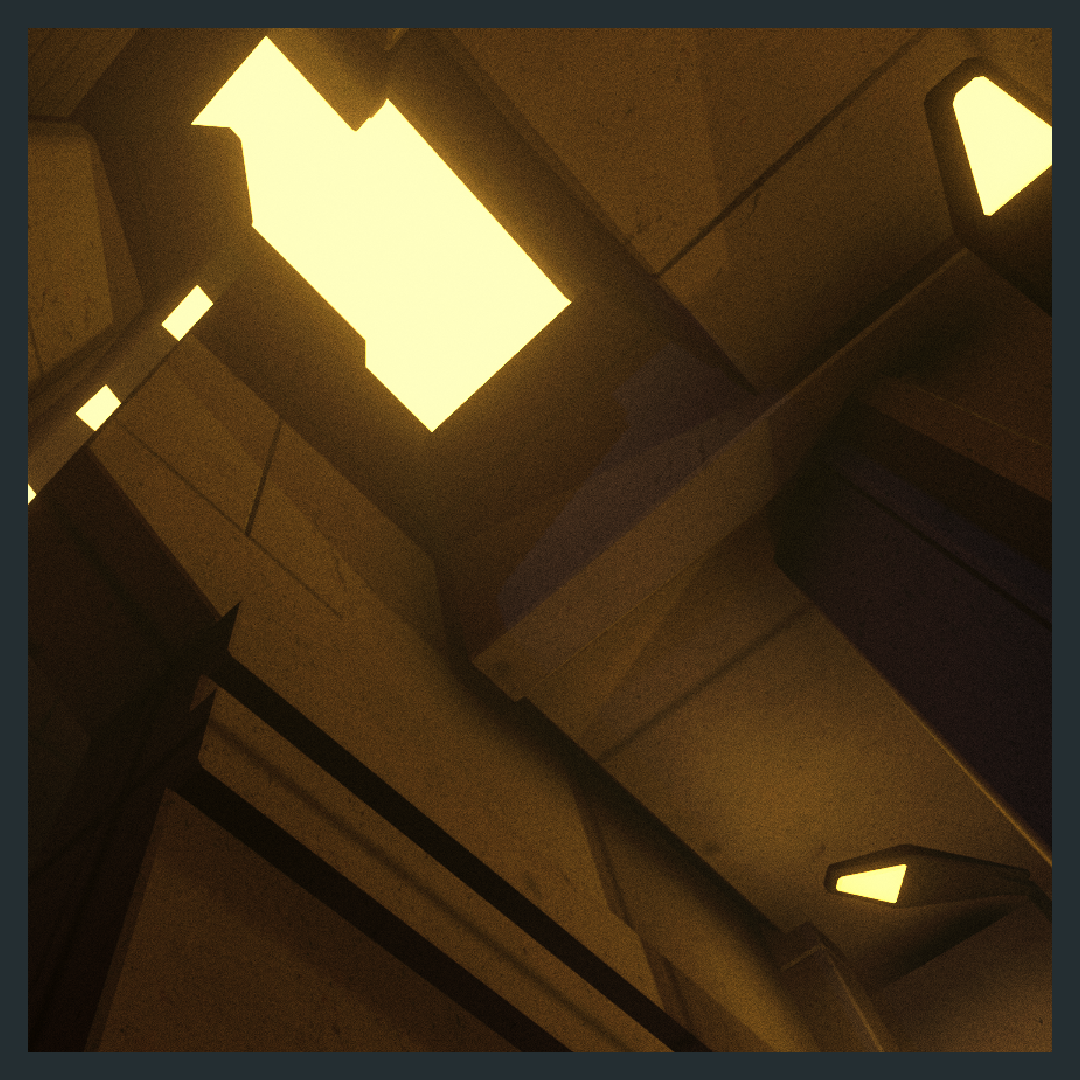
Brutalism in Virtual Reality

Image: Moshe Linke

Moshe Linke creates beautiful art games in which you can freely explore Brutalist environments. Most of them can be downloaded here: https://moshelinke.itch.io 

Here are a couple of our favorite images from his work:

Fugue in Void

According to the developer’s description:

Explore all kind of mysterious places and dive into a world full of atmosphere. Let this experience unfold in your head.  Let it inspire you.

Brutalism - Prelude on Stone

According to the developer’s description:

Brutalism: Prelude on Stone was a rather small project for me under the theme "Forces".  It is a small installation art exhibition set in brutal environment. You can freely explore a huge brutalist building. Here and there you are going to find art installations. All the art installations deal with the elements and nature. With it comes a rich soundscape that plays perfectly together with the visuals. I wanted to depict a harsh contrast between the elements and brutalist architecture. In the future there is still erosion from water, wind and other forces.

Wonders Between Dunes

According to the developer’s description:

Travel through a wonderful mysterious world and explore huge brutal architecture. Stroll through deserts. Stroll through lush jungles. Walk deep inside the belly of concrete monsters and feel the enormous weight of the city above you. Discover wonders between dunes.

A almost dream like experience waiting for you. Relax and take a break from all those action packed games out there.

Image: Moshe Linke

Image: Moshe Linke

Brutalism, with its simple forms and dramatic environments, is a powerful experience in virtual space.

With virtual gaming getting more popular, we look forward to the day we can virtually walkthrough a Paul Rudolph designed space. Until then, we will sit back and try not to look too far over the edge of that staircase.

Paul Rudolph's Walker Guest House For Sale

Image: © Ezra Stoller / Esto

Image: © Ezra Stoller / Esto

The Paul Rudolph Heritage Foundation has learned that Paul Rudolph’s iconic Walker Guest House will be for sale in the coming weeks. The listing will include the Walker Guest House and the main gulf-front residence on a 1.6 acre lot for $6,795,000.

The 1952 project was the first commission received by the thirty-four year old Rudolph after he left his partnership with Ralph Twitchell. Rudolph would later describe it as one of his favorite homes, saying the home “crouches like a spider in the sand.” The project would also be known as the ‘Cannonball House’ because of Rudolph’s use of red cannonballs as weights to hold the home’s signature wood panels in place.

Rudolph’s renderings showing the movable flaps for privacy. Image: Paul Rudolph Heritage Foundation Archives

According to Rudolph in the 1970 book The Architecture of Paul Rudolph by Sibyl Moholy-Nagy,

"Two bays on each side of this guest cottage are filled with pivoting panels which function as
1  the enclosing wall,
2  the ventilating element,
3  the shading device,
4  the hurricane shelter.
The third bay is filled with glass, to admit light and splendid views. When the panels are closed, the pavilion is snug and cave-like, when open the space psychologically changes and one is virtually in the landscape."

Plan with raised wall elements.  Two sections each of all four walls can be swung upwards into a horizontal position, steel balls suspended from steel cables provide counter balances.  All connections of the white painted wooden structure are joined…

Plan with raised wall elements. Two sections each of all four walls can be swung upwards into a horizontal position, steel balls suspended from steel cables provide counter balances. All connections of the white painted wooden structure are joined by screws. Image: Paul Rudolph Heritage Foundation Archives

Author Tim Rohan wrote about the significance of the guest house in Curbed,

The Walker House was Rudolph's complex tribute to and critique of the International Style's most celebrated dwelling, the Farnsworth House by Mies van der Rohe (Plano, IL, 1946-51). With its lightweight, white wood frame, the Walker House was Rudolph's "poor man's" version of the Farnsworth's expensive white, steel frame, whose beauty he could not help but admire. Rudolph corrected the main drawback of the Farnsworth House, evident as well in the Glass House (New Canaan, CT, 1945-49) by Philip Johnson: lack of privacy. Edith Farnsworth felt exposed by her house's glass walls, which she was powerless to change. For privacy, Johnson retreated to the almost windowless confines of his adjacent Brick House. Rudolph rectified this drawback by allowing the user to adjust the shutters of the Walker House for privacy and to suit their moods. Rudolph explained, "With all the panels lowered the house is a snug cottage, but when the panels are raised it becomes a large screened pavilion. If you desire to retire from the world you have a cave, but when you feel good there is the joy of an open pavilion." The Walker House set Rudolph upon the path to concluding that architecture was the art of manipulating space in order to affect and reflect human emotions, as was evident from the interior complexity of his Brutalist buildings, the most famed being his Yale Art & Architecture Building (New Haven, CT, 1958-63).

Many architecture students have studied the design and built models of it while in school making it one of Rudolph’s best known early works along with his 1961 Milam Residence. The home was also recognized by the AIA Florida chapter as ‘Best Residential Building in the State of Florida’ in 2012.

Please spread the word about the upcoming sale and if you know anyone interested in preserving the house, please reach out to us at office@paulrudolphheritagefoundation.org

Paul Rudolph's 1952 Sanderling Beach Club is one of the 'Florida Buildings I Love'

Photo: Paul Rudolph Heritage Foundation Archives

Photo: Paul Rudolph Heritage Foundation Archives

Harold Bubil, Real Estate Editor Emeritus for the Herald-Tribune, writes in the newspaper that Paul Rudolph’s Sanderling Beach Club is one of his favorite buildings in Florida.

The project was begun when developer Elbridge S. Boyd originally formed Siesta Properties, Inc. in 1946 with the plan to create a residential community in the area. In 1951, a homeowners association for residents of Siesta Properties known as the Siesta Club was founded. A year later in 1952, a cabana club was proposed to house guests of the local residents.

According to the website Satasota History Alive,

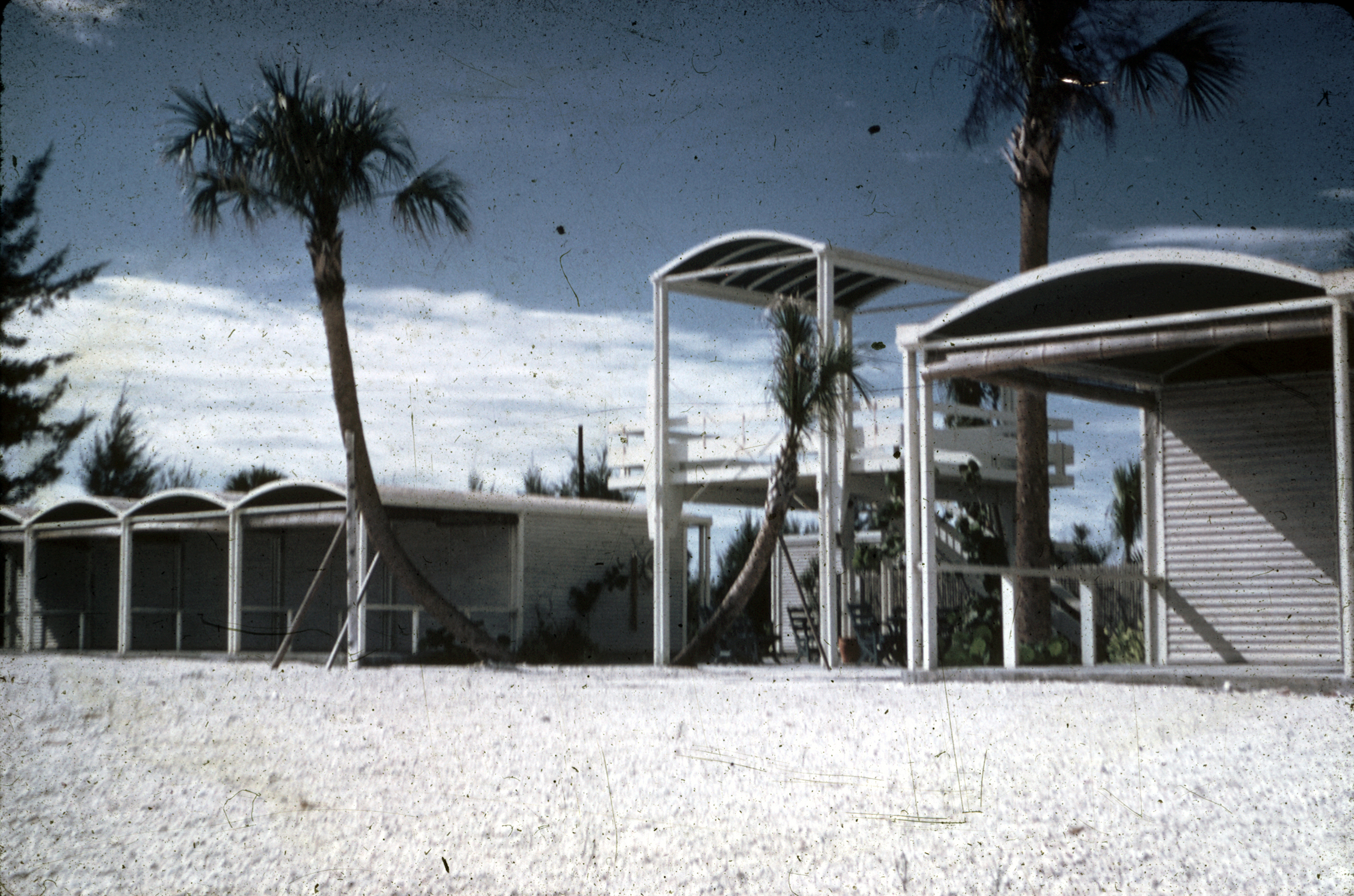
Local architect Paul Rudolph was selected to design the clubhouse, cabanas and observation tower. The initial phase, built in 1952, consisted of a concrete patio with a small white wooden observatory. The platform, about 10 feet up, was reached by a simple set of stairs, along the east side and furnished with chairs and a table. On either side of the patio was a single-story structure containing five cabanas each. A two-bay restroom building was located east of the tower. Each of these structures displayed a distinctive roof consisting of a series of shallow vaults constructed of thin plywood. Several resident-members participated in the construction of these early buildings.

Rudolph’s first proposal for the project. Image: Paul Rudolph Heritage Foundation Archives

Rudolph’s final proposal - note the revised design of the lookout. Image: Paul Rudolph Heritage Foundation Archives

Rudolph’s final proposal - note the revised design of the lookout. Image: Paul Rudolph Heritage Foundation Archives

Rudolph’s rendering of the final scheme. Image: Paul Rudolph Heritage Foundation Archives

Paul Rudolph looking out from the constructed observatory. Photo: Library of Congress

According to the website Satasota History Alive:

By 1958 three more buildings, with five cabanas each, were constructed by local contractor John Innes. Three new cabana buildings, which followed Paul Rudolph's design for the original two buildings, were arranged in a stepped line extending south of the original group. “A tennis court had been built, a life boat and telephone provided a measure of swimming safety to the area, and Sunday lunches were being held underneath table umbrellas.”

A clubhouse was not constructed until 1960, although included in Rudolph's original plans. John Crowell was hired to prepare the plans for the new two-story building. It was to abut the existing restroom building on the south and contain five Rudolph-style cabanas on the second floor. It was also expected to align with the shell roofed observation tower. However, a lack of structural integrity was recognized in the tower soon after its construction. For a time people were no longer allowed on the platform. The entire tower was torn down in the late 1960s.

The current site. Photo: Google Maps

Typical Cabana Floor Plan. Image: Paul Rudolph Heritage Foundation Archives

Writes Bubil:

The Gulf-front site demanded modestly sized structures that sat lightly on the sand and provided shelter for the tenants, some of whom have rented their cabanas for decades and have decorated the interiors to suit personal tastes and needs.

Rudolph’s early Sarasota structures often were experiments, and that was the case at Sanderling. The arched roofs are made from curved plywood, a material he learned about while serving at the Brooklyn Navy Yard during World War II. The posts are economically made of doubled-up 2-by-4s.

But it is the spirit of the cabanas that defines Rudolph’s creativity. The wave-like form of the roofs is appropriate for the site, and the simply geometry of the cabanas makes them look like delicately sized temples for sun worshipping.

On June 29, 1994, the project was added to the U.S. National Register of Historic Places.

Previously unseen Rudolph project donated to the Foundation's archives

Rudolph’s Medical Arts Building project in Singapore. Image: Paul Rudolph Heritage Foundation Archives

Rudolph’s Medical Arts Building project in Singapore. Image: Paul Rudolph Heritage Foundation Archives

Paul Rudolph’s 1990 proposal for a Medical Arts Building in Singapore was donated to the archives of the Paul Rudolph Heritage Foundation by Jeremy Moser, a former Rudolph employee. He also donated other project materials which will be covered in future posts.

The site today. Image: Google Maps

Rudolph’s proposed site plan. Image: Paul Rudolph Heritage Foundation Archives

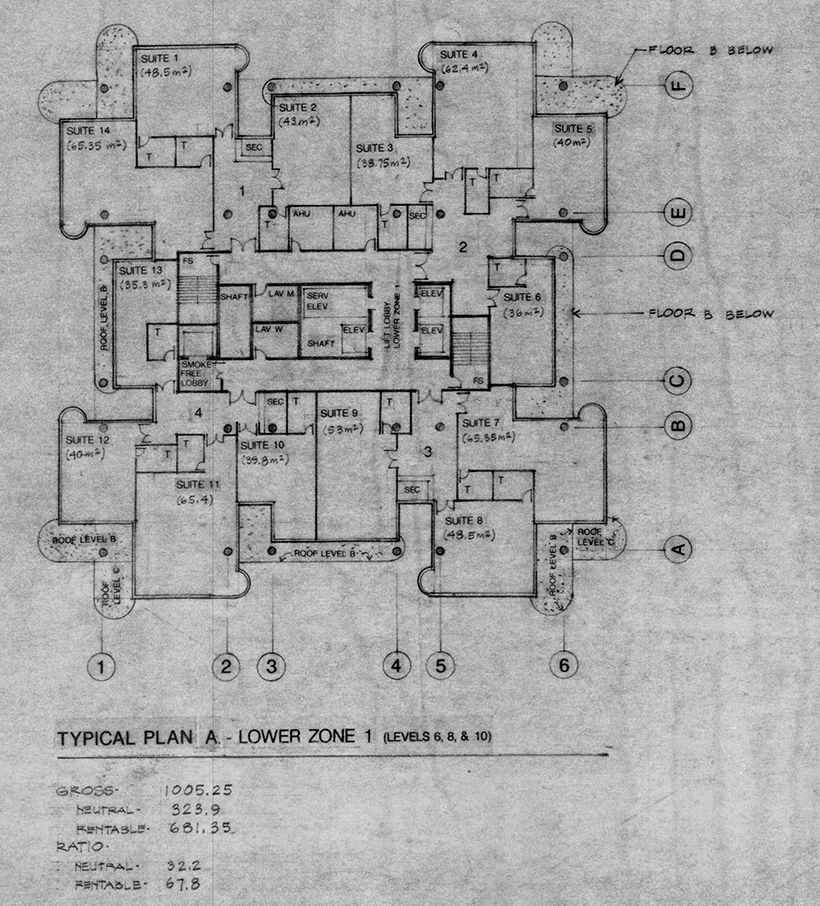
The project was never built. Along with a site plan and elevation, copies of the floor plans showing Rudolph’s characteristic alternating pinwheel floorplans:

The plans are dated February 16th, 1990 and list Rudolph’s office as 246 East 58th Street. Rudolph’s offices were on the second floor of the building, where the offices of the Paul Rudolph Heritage Foundation are located today.

Photos of Rudolph's residence added to the archives of the Paul Rudolph Heritage Foundation

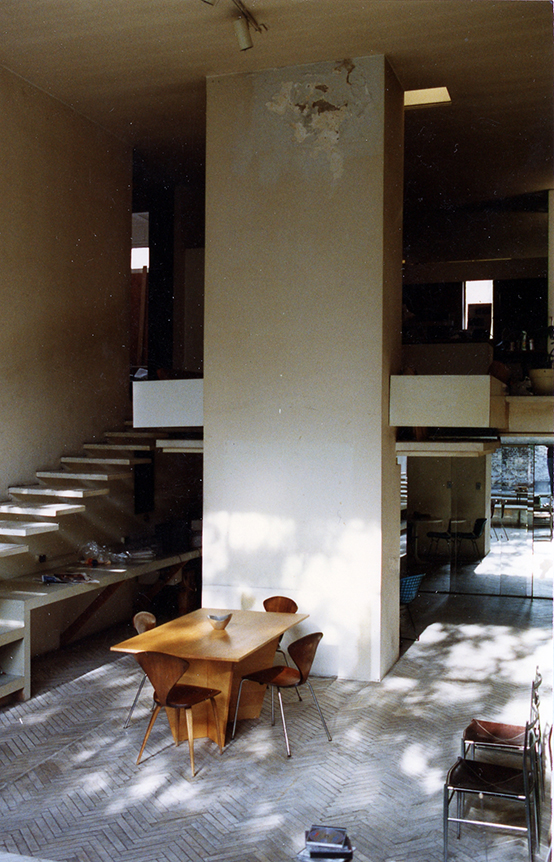
Photo of Rudolph’s residence taken in the early 90’s. Photo: Robert Schwartz; Paul Rudolph Heritage Foundation Archives

Photo of Rudolph’s residence taken in the early 90’s. Photo: Robert Schwartz; Paul Rudolph Heritage Foundation Archives

The Paul Rudolph Heritage Foundation was visited by Robert Schwartz, an architect who came to see the recent exhibit, ‘Paul Rudolph: The Personal Laboratory’ at the Foundation’s headquarters in the Modulightor building which featured Mr. Rudolph’s residence on 31 High Street. Afterwards, he spoke to us and showed photos of the space when he lived there from 1990-1993.

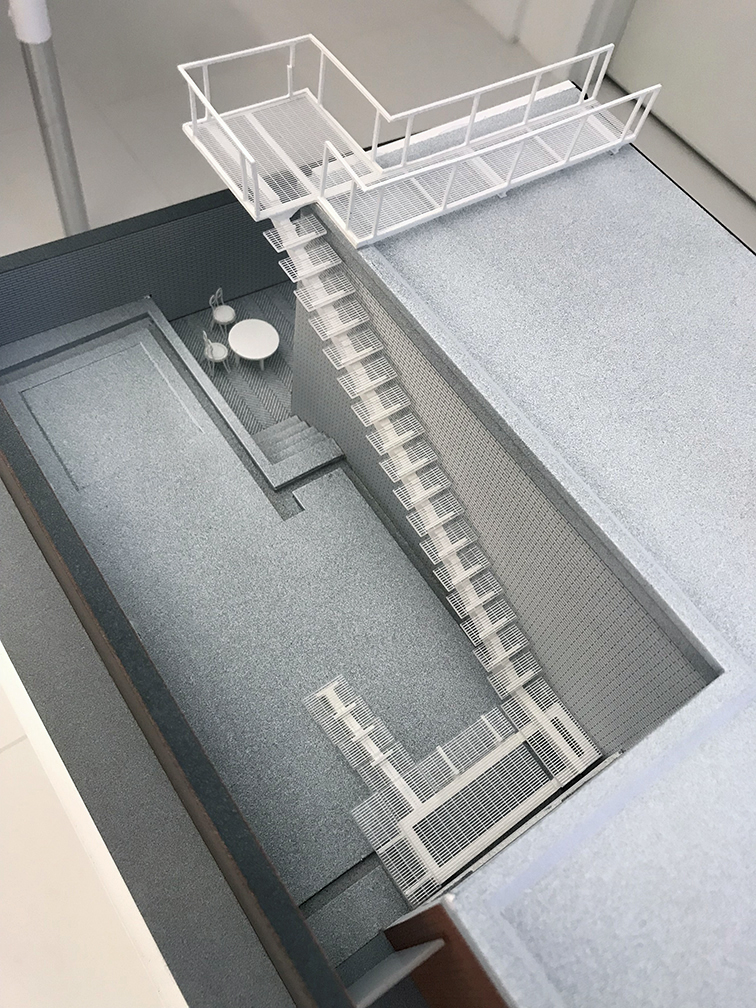
He donated copies of the photos to the Foundation’s growing archives of Paul Rudolph’s architectural works. These will be used to update the model which was based on Mr. Rudolph’s drawings and black and white historical photos.

Rudolph’s drawing of the first floor. Image: Paul Rudolph Heritage Foundation Archives

Rudolph’s drawing of the first floor. Image: Paul Rudolph Heritage Foundation Archives

Rudolph’s drawing of the second floor. Image: Paul Rudolph Heritage Foundation Archives

Rudolph’s drawing of the second floor. Image: Paul Rudolph Heritage Foundation Archives

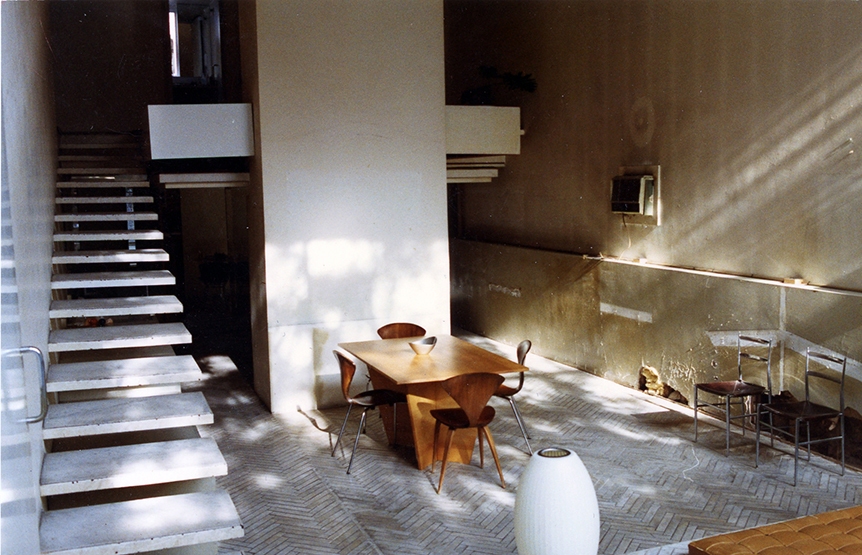
According to Mr. Schwartz, the floor was white marble (we had assumed brick!) in a herringbone pattern. The steps were the same white marble inset into a metal frame, hung off the wall. The brown cushion shown in the photos was original from Rudolph’s design.

Mr. Schwartz noted a few errors in the model such as a small water feature located outside in the yard. He also said the house had a number of tenants after Mr. Rudolph moved out before he lived in the space - including a rumored funeral parlor. He also pointed out details like doors and areas of the building that were not included in Rudolph’s drawings of the addition.

Sadly, the building was eventually turned into a residence for a local fraternity who made major changes including enclosing Rudolph’s floating staircase.

Thanks to Mr. Schwartz’s contribution to the Foundation’s archives we have another chapter to add to the history of this iconic project. For more photos, please see the links below.


Paul Rudolph's Rolling Chair now available for sale to the public

The Paul Rudolph Rolling Chair Photo: Modulightor

The Paul Rudolph Rolling Chair Photo: Modulightor

Paul Rudolph’s sketch of the original design Image: Library of Congress

Paul Rudolph’s sketch of the original design
Image: Library of Congress

This chair was designed by Paul Rudolph (1918-1997), one of America’s greatest Modern architects. Rudolph was famous for his strong, expressive forms, powerful spaces, and innovative use of materials & light. A very prolific designer of both architecture and interiors, his active career extended to nearly the end of the 20th century, and across the decades he continued developing his aesthetic and experimenting with space & materials.

Rudolph’s own residences were his “laboratories” for exploring ways to shape space and create dynamic forms. When he was looking for furniture for his own home, he found that there was nothing on the market that would fit well with the interiors he was creating - so he designed his own furniture, of which this chair is a prime example.

Paul Rudolph was thoroughly knowledgeable about design history - and had met many of the leading figures of 20th Century architecture. One can see the roots of this chair’s design in the work of Rietveld and Le Corbusier, both architects greatly admired by Rudolph. But, as with all his work, Rudolph puts his own creative stamp on the design - in this case: using a system of modular components to create furniture of great visual lightness & transparency. In addition, its use of casters makes it very flexible for moving into a variety of room arrangements.

Above: After he designed the chair, Paul Rudolph had an employee produce documentation of the design Images: Library of Congress

Rudolph was intensely interested in the flexibility and efficiency offered by modular systems. Whether it be for the design of a large-scale building, a set of furniture, or a light fixture, he thought architects should “speak the language of modularity.” This chair uses a system of stainless steel tubes & joints, carefully fabricated and assembled, to create a practical piece of furniture and a fine object of design. This same system can be also be used to make other kinds of furniture, and even light fixtures.

NOTE:  This chair is made by Modulightor, a company co-founded by Paul Rudolph and Ernst Wagner. This chair is often used in conjunction with other furniture designed by Rudolph: the Rolling Side Table and the Small Side Table. They’re also made by Modulightor and are available, and can be viewed on their website www.modulightor.com If you have any questions about the chair and how to order one, please email us at office@paulrudolphheritagefoundation.org

Specifications:

  • Title:  Paul Rudolph Rolling Chair

  • Size:  Approx. 29-3/8” tall  x  approx. 28” wide  x  approx. 22-1/2” deep (Note: All dimensions are approximate.)

  • Material:  Stainless steel, Plexiglas, and casters

  • Manufactured and Sold By:  This Paul Rudolph-designed chair is made and sold by Modulightor - a firm co-founded by Paul Rudolph

Pricing & Availability:

  • Price:  $3,450   Note: a portion of the proceeds from each sale will be donated to the Paul Rudolph Heritage Foundation.

  • Availability:  Any quantity is available

  • Ordering:  Must be pre-ordered and pre-paid. Please email office@paulrudolphheritagefoundation.org to order

  • Lead Time:  Approximately 8 weeks, from receipt of paid order

Shipping & Packing:  Will depend on the destination. The purchaser can either:

  • Pick-up the chair at Modulightor’s New York City showroom

  • Make their own arrangements to have it crated and shipped

  • Arrange for Modulightor to have it crated and shipped (at additional cost, to be determined based on destination)

'Paul Rudolph: A Way of Working' greeted by full house at the Center for Architecture

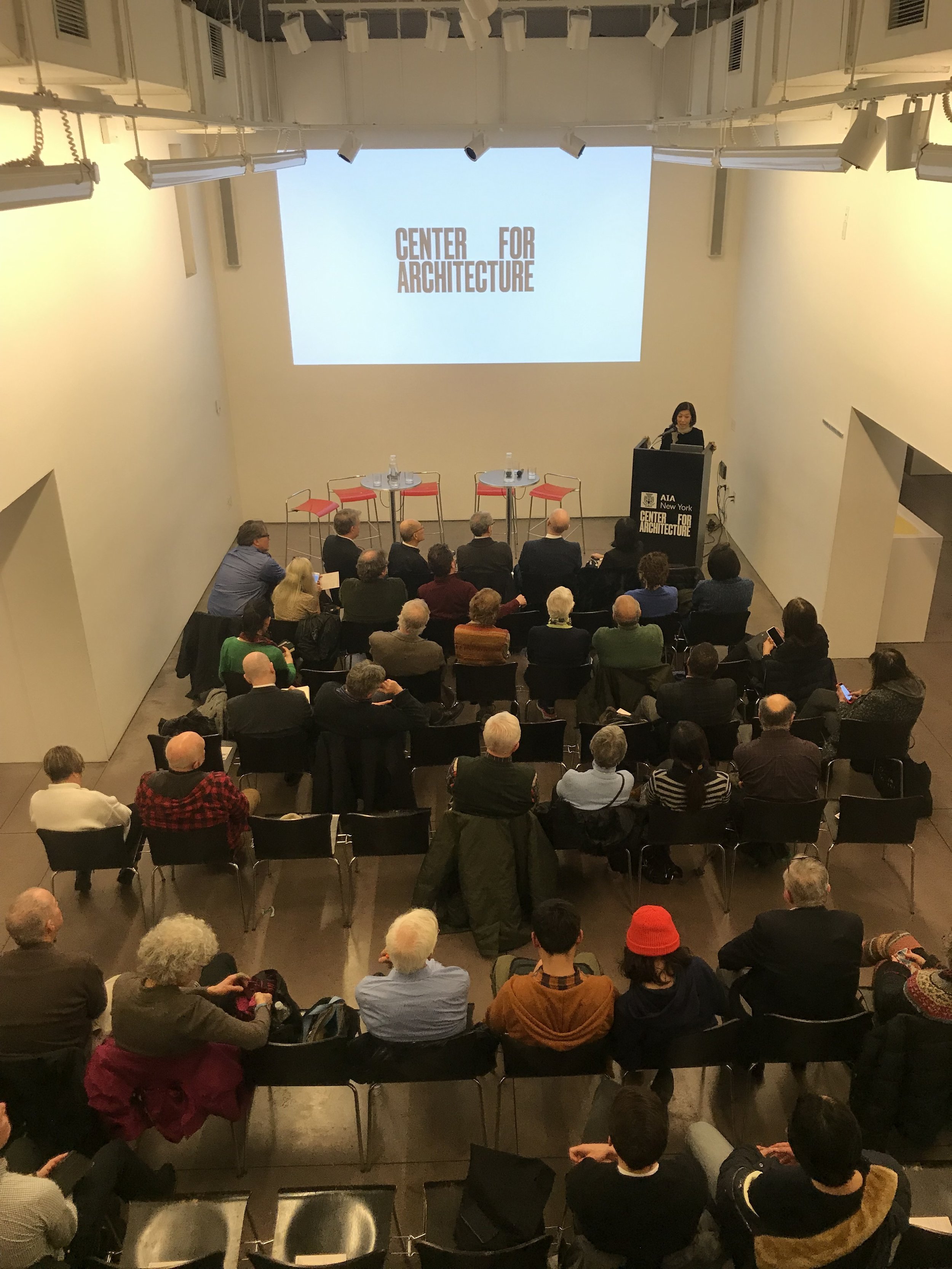
Speakers Rocco Leonardis, R.D. Chin, Jeremy Moser, Nora Leung and moderator Roberto de Alba. Photo: Kelvin Dickinson, Paul Rudolph Heritage Foundation

Speakers Rocco Leonardis, R.D. Chin, Jeremy Moser, Nora Leung and moderator Roberto de Alba. Photo: Kelvin Dickinson, Paul Rudolph Heritage Foundation

On Friday December 14 The Paul Rudolph Heritage Foundation joined the Center for Architecture for a special presentation, ‘Paul Rudolph: A Way of Working’. The program was presented in coordination with the exhibition ‘Paul Rudolph: The Hong Kong Years’ on display in the gallery adjacent to the event.

The night began with an introduction about the Paul Rudolph Heritage Foundation by President Kelvin Dickinson. Roberto de Alba, author of the book ‘Paul Rudolph - the Late Years’, introduced keynote speaker Nora Leung who spoke about her experience working with Mr. Rudolph on several projects in Hong Kong.

The program concluded with a panel discussion featuring several past employees speaking about what it was like to work with Mr. Rudolph.

The event was part of the Paul Rudolph Centennial which features two exhibitions about his work. For more information about the two exhibits celebrating Mr. Rudolph’s life and work for his centennial please follow this link.

Upcoming lecture: 'Paul Rudolph: Influences & Opportunities' at the Center for Architecture

Paul Rudolph asking concrete what it wants to be.  Photo: Library of Congress

Paul Rudolph asking concrete what it wants to be. Photo: Library of Congress

Please join the Paul Rudolph Heritage Foundation
for a special program for Paul Rudolph: The Hong Kong Journey.
 

PAUL RUDOLPH:
INFLUENCES & OPPORTUNITIES


Wednesday, December 19 2018
6pm-8pm


At the Center For Architecture
536 LaGuardia Place, New York, NY 10012


For reservations, go to the Center for Architecture’s site here.


Paul Rudolph considered an allowance for growth in his architecture and once said his buildings “took on a life of their own” after they were designed.  The Paul Rudolph Heritage Foundation in association with the Center for Architecture present a panel speakers influenced by the richness of Paul Rudolph’s architectural legacy. The program will present stories by those who have had the the opportunity to adapt his work to present-day needs.

Introduction:
Kelvin Dickinson, President, Paul Rudolph Heritage Foundation

Speakers:
Kate Wagner, Founder, McMansionHell
Eric Wolff, Owner, the Fullam Residence
John Wolstenholme, AIA, LEED AP, Principal, Wolstenholme Associates LLC
Andrew Bernheimer, FAIA, Principal, Bernheimer Architecture
Robert Miklos, FAIA, Founding Principal, designLAB architects
Ben Youtz, AIA, designLAB architects
Kelly Haigh, AIA IIDA, design LAB architects
 

For more information about the event go to our website here.
For speaker bios follow the link here.

Rudolph's view of the UN General Assembly building

Dag Hammarskjöld outside the UN building in 1953. Photo: Dag Hammarskjöld Foundation

Dag Hammarskjöld outside the UN building in 1953. Photo: Dag Hammarskjöld Foundation

Paul Rudolph was a fan of Le Corbusier's work. So much so, that he radically changed his design of the Art & Architecture building at Yale following a visit to Corbusier's chapel at Ronchamp. But his criticism could be as strong as his praise.

A friend of the Foundation alerted us to the following excerpt from the February 1st, 1953 edition of the Sydney Herald about the then-recently completed United Nations building:

Walking through the General Assembly building for the first time last month, a prominent younger-generation American architect, Paul Rudolph, disliked what he saw. ‘It brings the so-called International style close to bankruptcy,’ he said in “Architectural Forum” ‘The building is not really a product of the International style, but rather a background for a grade B movie about “one world” with Rita Hayworth dancing up the main ramp.

Ouch.

Is that a look of anticipation in Dag Hammarskjold's face while he waits for the show to begin?

If you have a favorite quote you found and you'd like to share, let us know!

Paul Rudolph, The 'Future' and Brain Science

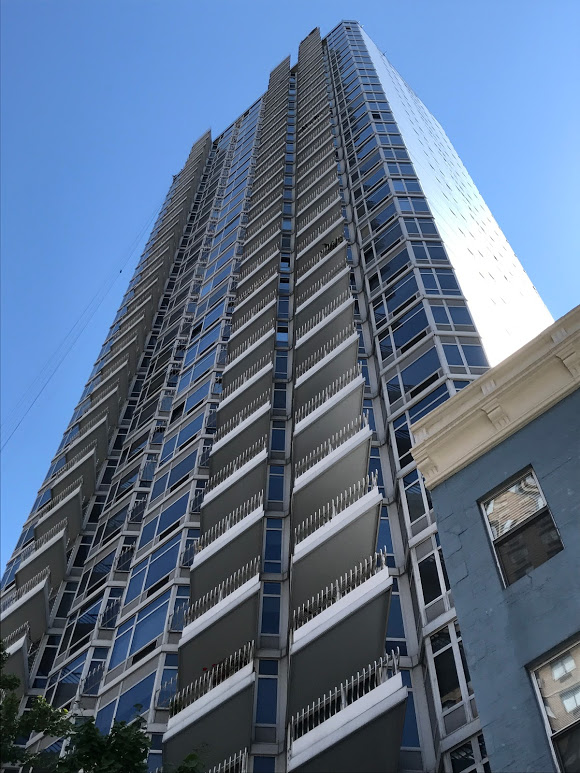
The Future Condominiums. Photo: Kelvin Dickinson, Paul Rudolph Heritage Foundation

The Future Condominiums. Photo: Kelvin Dickinson, Paul Rudolph Heritage Foundation

Paul Rudolph’s design of the exterior of the Future Condominium is used as an example of optical illusion in the article ‘Can we change our vantage point to explore imaginal neglect?’ published in Behavioral and Brain Sciences by Paolo Bartolomeo and Sylvie Chokron.

Image: Behavioral and Brain Sciences

Image: Behavioral and Brain Sciences

Write Bartolomeo and Chokron,

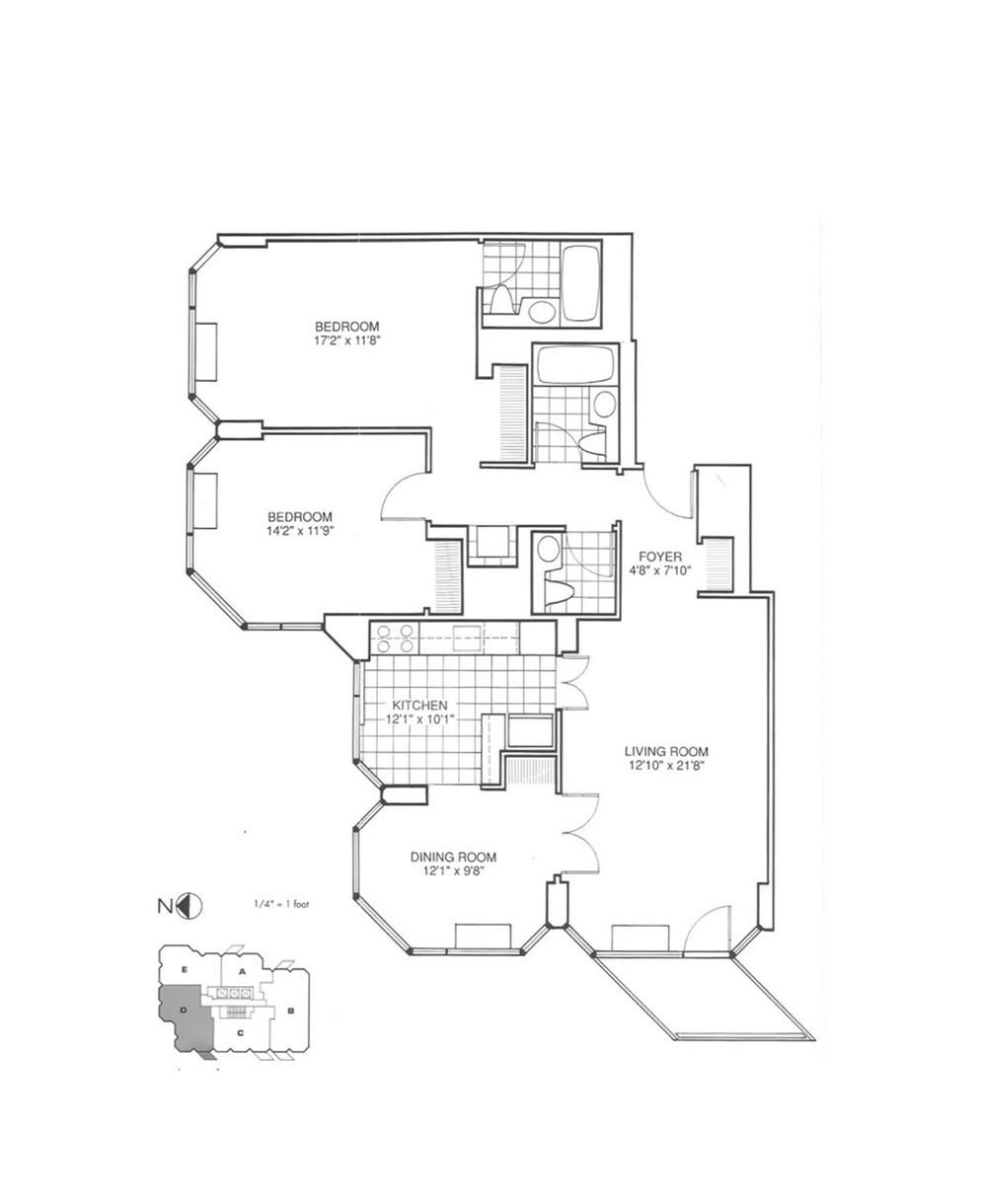
The objects in Figures 1 and 2 were designed to represent the salient features of a building, two views of which are shown in Fig-ure 3 (Griffiths & Zaidi 2000; Halper 1997). Notice that in the left panel the balconies seem implausibly tilted up, whereas in the right panel they implausibly appear tilted down. A frontal view of the building reveals the balconies to be horizontal parallelograms.

This knowledge never weakens the illusion.

Image: Behavioral and Brain Sciences

Image: Behavioral and Brain Sciences

Paul Rudolph’s building exterior. Photo: Nicolas Janberg

Paul Rudolph’s building exterior. Photo: Nicolas Janberg

The 35-story building, located at 32nd Street and Third Avenue, was built in 1990-1993.

Floor plan showing the parallelogram shape of the balconies. Image: Douglas Elliman

Floor plan showing the parallelogram shape of the balconies. Image: Douglas Elliman

The building has 165 condominium apartments and was developed by Donald Zucker. It was designed by Costas Kondylis with Paul Rudolph as consulting architect for the building’s distinctive exterior.

Rudolph inspired dollhouse for your 'miniature Modernist'

The Dylan House. Photo: Brinca Dada

The Dylan House. Photo: Brinca Dada

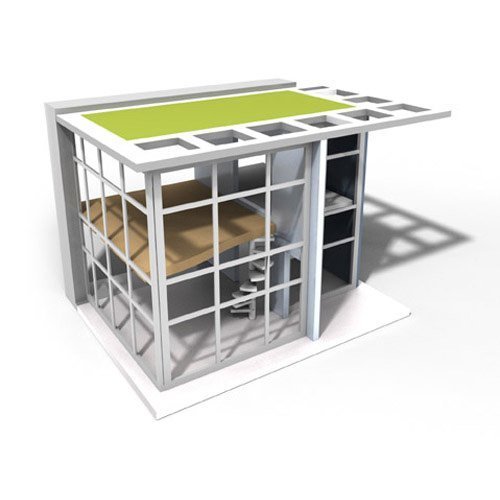
Who says a dollhouse has to be Victorian? If you are looking for a cool holiday gift to inspire a young future architect, we found some amazing examples at Brinca Dada. The above caught our attention for an obvious reason:

Inspired by the minimalist masterpieces of Paul Rudolph and Tadao Ando, the brinca dada Dylan Dollhouse House with Furniture features a concrete-and-glass feel, but with the breezy openness of a beachfront home. Floor-to-ceiling windows open to allow natural light into the house and play from many angles. The Dylan House has five living spaces on three levels: living room/dining room, kitchen, bedroom, bathroom and roof patio. The Dylan House Furniture set contains 23 pieces...enough to fill five living spaces on three levels: living room/dining room, kitchen, bedroom, bathroom and roof patio. Furnish their imagination with this awesome complete dollhouse and furniture set.

We’re not sure the above is very Rudolphian, but it may have taken a cue from his Florida work:

Do you see a resemblance? Neither do we…. Photo: Kelvin Dickinson, Paul Rudolph Heritage Foundation

Do you see a resemblance? Neither do we…. Photo: Kelvin Dickinson, Paul Rudolph Heritage Foundation

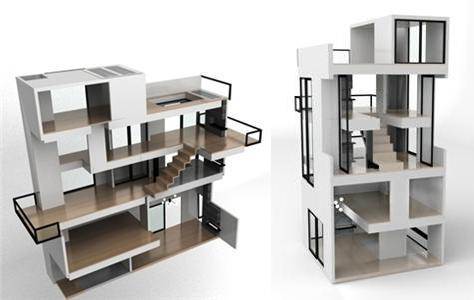
Brinca Dada also makes other options for your miniature Modernist which remind us a little of Paul Rudolph’s Quadruplex at 23 Beekman Place:

The Bennett House. Photo: Brinca Dada

The Bennett House. Photo: Brinca Dada

All that’s missing is a lot of chrome and some Plexiglas furniture. And is that hole on the roof where the bathtub is supposed to be?

Paul Rudolph Featured in Docomomo US 'Doco Games' for Giving Tuesday

VOTEFORRUDOLPH.jpg

Paul Rudolph’s Burroughs Wellcome Headquarters, Shoreline Apartments and Niagara Falls Public Library are featured in Docomomo’s ‘first ever battle for architectural survival with the “Doco Games.” 

According to the organization’s website,

The #DocoGames is a day-long tournament that features sixteen of Docomomo US’ biggest supporters fighting to save a building they love.

Armed with razor-sharp adjectives like “rectilinear”, “articulated” and “brutalist”, the #DocoGames will begin promptly at 10:00 AM Eastern on Tuesday, November 27th, with four (4) rounds of players advancing every two (2) hours. Each of the (16) sixteen players will encourage friends and colleagues through social media channels to give to Docomomo US throughout the day.The player who brings in the most money during each round will advance to face a new player. 

Round 1 pits Mr. Rudolph’s architecture against such notable works as SOM’s Union Carbide Building, Richard Neutra’s George Kraigher residence and M. Paul Friedberg’s Peavey Plaza in downtown Minneapolis, Minnesota.

While we don’t want to take sides, we ENCOURAGE YOU TO SUPPORT TEAM RUDOLPH!

Support Tim Hayduk’s love of “PAUL RUDOLPH'S SCULPTURAL ARCHITECTURE” by following this link

Support Kate Wagner’s idea of “BRUTALIST HEAVEN” by following this link

Support Barbara Campagna’s aversion to ‘VICTORIANA’ by following this link.

Celebrated on the Tuesday following Thanksgiving (in the U.S.) and the widely recognized shopping events Black Friday and Cyber Monday, #GivingTuesday kicks off the charitable season, when many focus on their holiday and end-of-year giving. Since its inaugural year in 2012, #GivingTuesday has become a movement that celebrates and supports giving and philanthropy with events throughout the year and a growing catalog of resources.

Please support Docomomo’s efforts to preserve Modernism and may the BEST RUDOLPH WIN'!

Rudolph's Woman's Home Companion house rendered in 3D

Image: Woman's Home Companion

Image: Woman's Home Companion

In 1956, the Woman's Home Companion magazine commissioned a house designed by Paul Rudolph. Tim Hills, who runs a vintage design and furnishing team based in Kalamazoo, Michigan known as Trystcraft, recreated 3d renderings of the proposed home after careful study of plans and renderings found in the magazine.

Image: Woman's Home Companion

Image: Woman's Home Companion

Image: Woman's Home Companion

Image: Woman's Home Companion

Using addresses published at the time, Tim was able to track down two additional versions beyond the one that is considered online as the only realized project.

Floor Plan of the house. Image: Woman's Home Companion

Floor Plan of the house. Image: Woman's Home Companion

To read more including vintage photos and the story behind his work, follow this link and click the links below to see larger images.

Rudolph's Cocoon House captured in new video

The exterior in 2017. Photo: Kelvin Dickinson, Paul Rudolph Heritage Foundation

The exterior in 2017. Photo: Kelvin Dickinson, Paul Rudolph Heritage Foundation

Paul Rudolph’s Healy Guest House, known as the ‘cocoon house’ for its unique roof construction, is featured in a new video by the Sarasota Architectural Foundation.

According to the video’s description,

Located on Bayou Louise Lane on Siesta Key, Cocoon House is a two-bedroom, one-bath, 760-square-foot cottage built as a guesthouse for Mr. and Mrs. W. R. Healy. The house gets its name from the technology used to build its roof: a polymer spray that Paul Rudolph saw being used at the Brooklyn Navy Yard on warships returning after WWII in order to "cocoon" or moth-ball them. Rudolph's creativity made him realize that this material could also be used in the construction industry. The Cocoon House was named “Best House Design of the Year” from the AIA in 1949; selected by MoMA New York in 1953 as one of 19 examples of houses built since WWII that were "pioneers of design;” and locally designated as a historic property by the City of Sarasota in 1985.

To watch the two-minute video, click below or follow the link here.

Rudolph's Orange County Government Center featured in 'Architectural Drawings: 8 Masterful Parallel Projections'

Paul Rudolph’s Orange County Government Center is featured in an article on Architizer’s website blog titled ‘Architectural Drawings: 8 Masterful Parallel Projections’ by Orli Hakanoglu.

Writes Hakanoglu,

Existing somewhere between plan and elevation, axonometric views allow complex spaces to coexist within a single frame. Though the rules for producing one of these projections are quite rigid, the techniques and styles with which designers choose to represent space are highly varied. This collection takes a look at several applications of the drawing technique that artists and architects past and present use to convey big ideas.

Image: Paul Rudolph Heritage Foundation

Image: Paul Rudolph Heritage Foundation

Hakanoglu says about Paul Rudolph’s axonometric and sectional perspective for the Orange County Government Center:

Rudolph’s masterful hand drawings are a testament to the power of combining representational techniques to communicate multiple aspects of a building. An axonometric view and a section perspective work in tandem to communicate the exterior façade’s protruding rectilinear volumes as well as the interior space within them. The axonometric drawing is quite unusual in that it rotates the entire drawing in space to provide a ground-up view, which presents the building from a believable human viewpoint.

Rudolph’s use of axonometric and section perspective drawings were a signature way he used to communicate his ideas of architectural space. As Laurence Scarpa noted in his article ‘Paul Rudolph: Metaphors, Paradoxes, Contradictions and Abstractions’,

Everything he did was an obsessive open-ended exploration. Rudolph explained this process: “Before making any sketches I will really think about it a great, great, deal and, finally, I will resolve that into essentially three or maybe four—it depends on the project—schemes.” Rudolph had the ability to work with multiple ideas simultaneously. These explorations resulted in extraordinary discoveries. This insight allowed him both the freedom to explore and to problem solve without being encumbered by either. Rudolph would say to me, “Buildings do not happen, they must be made to happen.” While working at his desk, he would move his hand over his drawing in such a way that he could better understand the actual scale and what it might be like to occupy the drawing, as if it were an actual building. He seemed as though he was actually inside the drawing. He would touch with his eyes and see with his hands. He always included human figures in his drawing, particularly in section and elevation drawings, to further understand how the scale of the space related to an actual person. For Rudolph the drawing was a building at full scale. This concept was the origin of his creative process.

Paul Rudolph Inspires a Hotel Design in Texas

Image: Specht Architects

Image: Specht Architects

Paul Rudolph’s design of the Orange County Government Center in Goshen, New York may not have been appreciated by some in the local community, but its influence can be felt in a hotel designed by Specht Architects.

Click on one of the images below to see Specht Architect’s design for a hotel in Austin, Texas:

Images: Specht Architects

According to their website:

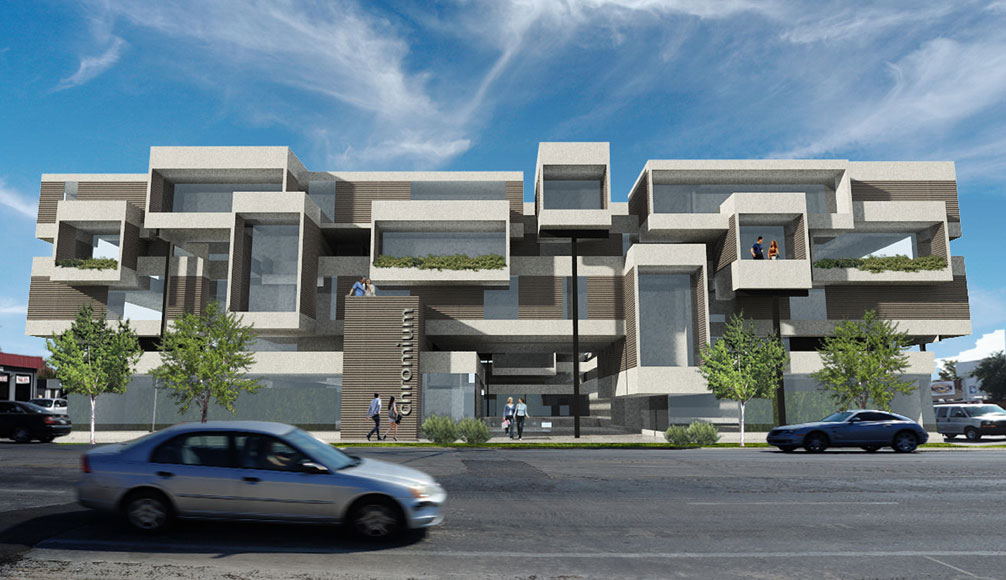
The Lamar Boulevard Hotel is a 150 room hotel, designed for a site just blocks from downtown Austin, TX. It features a large internal courtyard, and a series of stacked, terraced room modules that produce an almost organic cliff-like facade. Each room has a unique view, and a unique outdoor terrace.

Its form was inspired by the experimental metabolist architecture of the 1960’s that produced iconic works such as Habitat ’67 in Montreal, and the urban designs of Paul Rudolph.

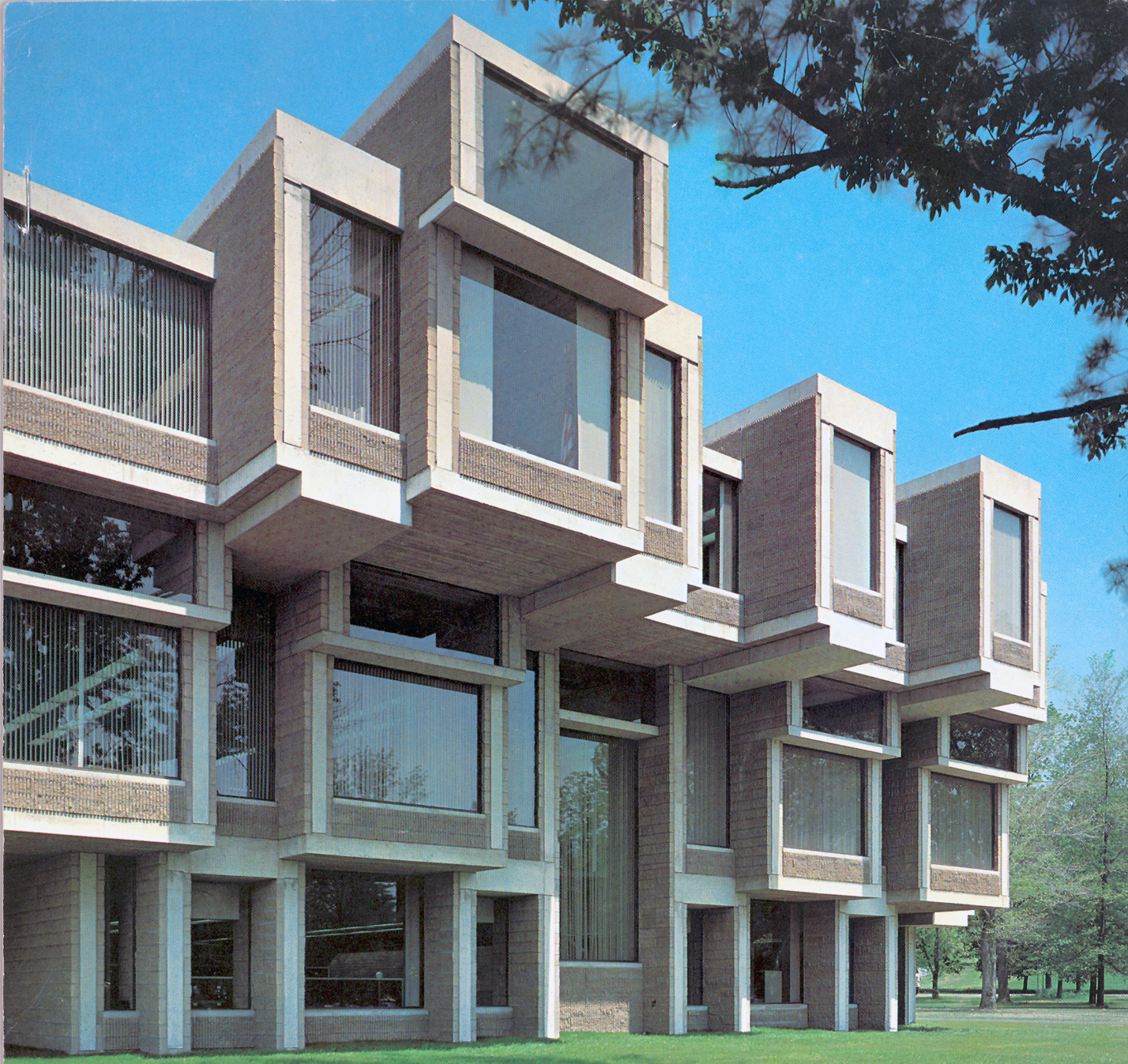
Paul Rudolph's Orange County Government Center in Goshen, New York. Photo: Paul Rudolph Heritage Foundation

Paul Rudolph's Orange County Government Center in Goshen, New York. Photo: Paul Rudolph Heritage Foundation

Paul Rudolph's Orange County Government Center in Goshen, New York. Photo: Kelvin Dickinson, Paul Rudolph Heritage Foundation

Paul Rudolph's Orange County Government Center in Goshen, New York. Photo: Kelvin Dickinson, Paul Rudolph Heritage Foundation

Both the hotel and Rudolph’s design for the Orange County Government Center take a cue from Rudolph’s interpretation of Mies’ use of space. Regarding the government center, Rudolph said,

The building is divided into three areas… These three areas are subdivided but closely grouped around a court, allowing the light to enter through a rather elaborate series of clerestories made possible by higher ceiling heights for the more important and larger rooms. In the interior, the enclosed volume of one room often penetrates the adjacent room, giving a sense of implied space beyond but allowing acoustical insulation. The resulting fragmented scale seems appropriate, since the building will be set in a small park and surrounded by residences relatively small in scale.

Rudolph’s rendering of the Orange County Government Center facade. Image: Paul Rudolph Heritage Foundation

Rudolph’s rendering of the Orange County Government Center facade. Image: Paul Rudolph Heritage Foundation

Paul Rudolph's 1950 Cocoon House is one of the 'Florida Buildings I Love'

The exterior in 2017. Photo: Kelvin Dickinson, Paul Rudolph Heritage Foundation

The exterior in 2017. Photo: Kelvin Dickinson, Paul Rudolph Heritage Foundation

Paul Rudolph’s rendering of the exterior. Image: Paul Rudolph Heritage Foundation

Paul Rudolph’s rendering of the exterior. Image: Paul Rudolph Heritage Foundation

Harold Bubil, Real Estate Editor Emeritus for the Herald-Tribune, writes in the newspaper that Paul Rudolph’s Healy guest house, known commonly as the Cocoon House, is one of his favorite buildings in Florida.

The exterior in 2017. Photo: Kelvin Dickinson, Paul Rudolph Heritage Foundation

The exterior in 2017. Photo: Kelvin Dickinson, Paul Rudolph Heritage Foundation

The reason for the name comes from the use of a technology - new at the time - to waterproof the roof. Writes Bubil:

During World War II, both Twitchell, who commanded an air base in South Carolina, and Rudolph, who was stationed at the Brooklyn Navy Yard, learned about new technologies materials that could be applied to residential construction. Rudolph took note of the sprayed-on vinyl used to mothball ships, called “cocoon.”

Paul Rudolph’s rendering of the exterior. Image: Paul Rudolph Heritage Foundation

Paul Rudolph’s rendering of the exterior. Image: Paul Rudolph Heritage Foundation

While many see the house as a landmark of the Sarasota School of Architecture for its simple structure, use of glass and elevation above the surrounding landscape - Rudolph saw it as a failure. Writes Bubil,

It was “OK on the outside, but the interior space was not successful,” Rudolph, who died in 1997, once told architect Peter Blake in an interview. “The apparent instability of the sagging ceiling and the thrusting of space upward to the perimeter, inviting you to leave — this violated the essential nature of an intimate, domestic space. The Healy Cottage taught me that the physiological nature of the space in every building was really more important than the form of the structure.”

Paul Rudolph’s rendering of the interior. Image: Paul Rudolph Heritage Foundation

Paul Rudolph’s rendering of the interior. Image: Paul Rudolph Heritage Foundation

The psychological effect of space would continue to occupy the rest of Rudolph’s career - making this important building one that Rudolph fans and followers of modern architecture can share with similar appreciation.

Remembering Paul Rudolph with Metropolis Magazine

Photography by Annie Schlecter, courtesy the Paul Rudolph Heritage Foundation

Photography by Annie Schlecter, courtesy the Paul Rudolph Heritage Foundation

Paul Rudolph’s Centenary and the Paul Rudolph Heritage Foundation’s exhibitions ‘Paul Rudolph: The Personal Laboratory’ and ‘Paul Rudolph: The Hong Kong Journey’ are covered in an online article in Metropolis by A.J.P. Artemel.

Writes Artemel,

There was a time when Paul Rudolph was the most famous architect, if not in the world, then at least in the United States. As the leading emissary of “heroic” Modernism, he was responsible for some of the most innovative and audacious concrete buildings of the 1960s. Current stars Richard Rogers and Norman Foster went to Yale to learn from him. But after the devastating, epoch-ending fire at Rudolph’s Art and Architecture Building at Yale and multiple broadsides penned by Postmodern critics, Rudolph’s stream of projects, as well as his American following, seemed to evaporate overnight. Though much of Rudolph’s work from his early period in Sarasota, Florida, and from the height of his career in the ’60s has been rehabilitated and rediscovered by new audiences, his later work—roughly defined, those buildings completed between 1970 and his death in 1997—remains relatively unknown.

Two exhibitions organized by the Paul Rudolph Heritage Foundation to mark the architect’s centenary aim to address this blind spot.

cover.jpg

It is indeed an exciting time to examine this material, not only in light of the anniversary but because of what this collection of buildings and designs may come to illustrate: a daring and often lonely effort to continue the Modernist project.

For more information about the current exhibition ‘Paul Rudolph: The Personal Laboratory’ at the Modulightor building, and the upcoming ‘Paul Rudolph: The Hong Kong Journey’ go to the Centennial page here.

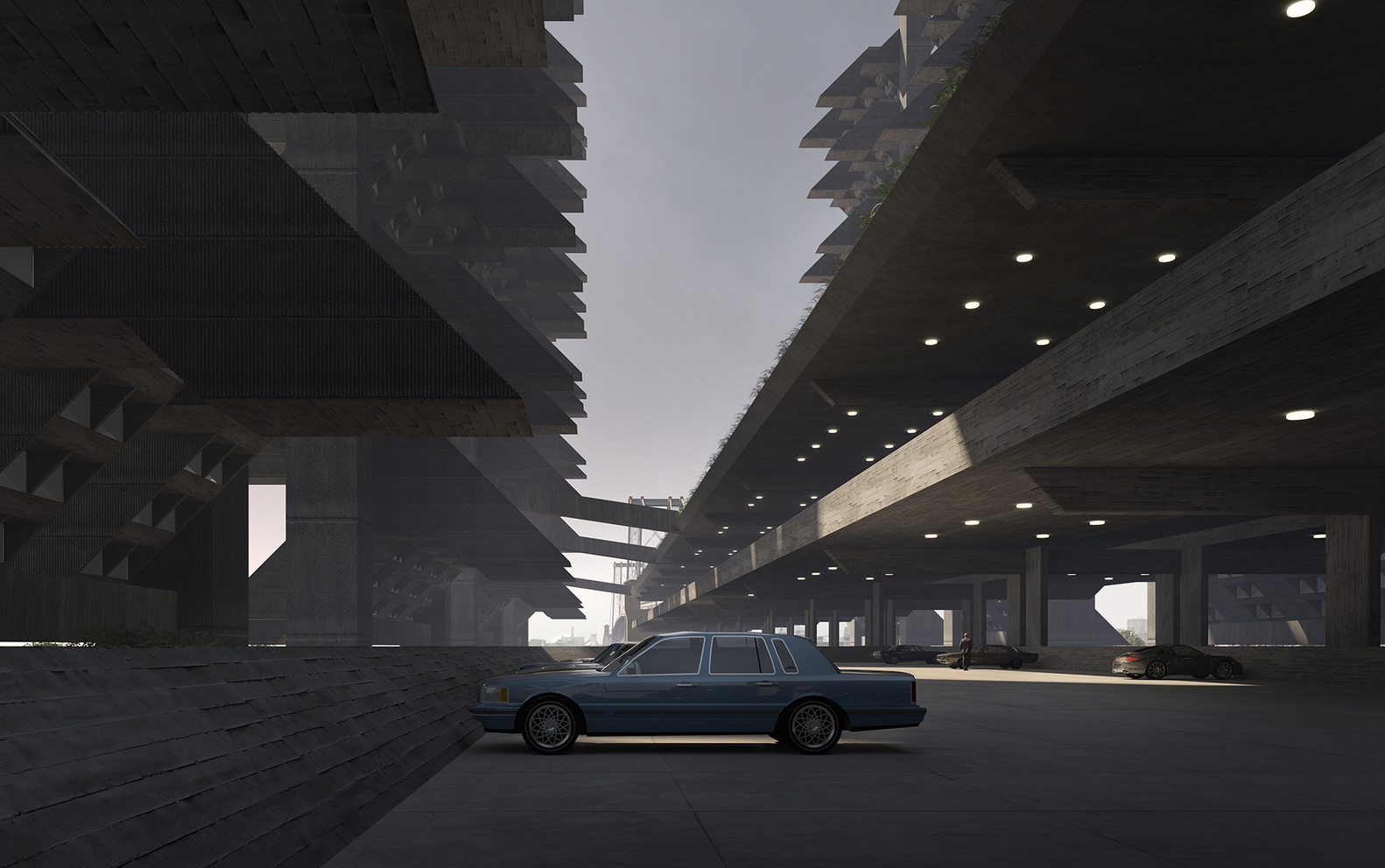
Rudolph's LOMEX project featured in new Renderings

View from a terrace in the high-rises. Image: Lasse Lyhne-Hansen

View from a terrace in the high-rises. Image: Lasse Lyhne-Hansen

Paul Rudolph’s Lower Manhattan Expressway project (LOMEX) has been digitally recreated by Danish designer Lasse Lyhne-Hansen. As featured on design websites Archdaily and Designboom, the work was created to celebrate Paul Rudolph’s 100th birthday.

Rudolph’s proposal for the Lower Manhattan Expressway. Image: Paul Rudolph Heritage Foundation

Rudolph’s proposal for the Lower Manhattan Expressway. Image: Paul Rudolph Heritage Foundation

Robert Moses originally conceived of the Lower Manhattan Expressway project in 1941 and given the authorization to proceed in 1960. After numerous protests, including notable figures such as Jane Jacobs, the project which was to be an elevated highway was replaced by a sunken highway with adjacent parks and housing.

Then, writes Phil Patton in the Architects Newspaper:

In 1967 the Ford Foundation, whose new head was McGeorge Bundy (formerly National Security Advisor during escalation in Vietnam), asked Rudolph—known for large-scale projects—to imagine a development that ameliorated the impact of the highway. He proposed topping the sunken freeway with a series of residential structures, parking, and plazas, with people-mover pods and elevators to subways. The shapes of the buildings echoed the Williamsburg and Manhattan bridges, and also recalled Hugh Ferriss’ ideas of bridge/buildings from 1929. Rudolph’s idea was organizing a new city core around modes of movement.

“This plan, unlike most, does not propose to tear down everything in sight; it suggests that we tear down as little as possible,” Rudolph said about the project at the time.

Rather than challenging the need for a massive highway that would have destroyed most of SoHo and Tribecca, Rudolph believed architecture could make the most of the given situation.

Rudolph’s original section perspective. Image: Paul Rudolph Heritage Foundation

Rudolph’s original section perspective. Image: Paul Rudolph Heritage Foundation

In 1971, the project was ended by Governor Nelson Rockefeller.

Decades later, a similar scale project - the 'Big Dig' in Boston - would install the 1.5 mile-long Rose Fitzgerald Kennedy Greenway series of parks and public spaces above its new underground highways.

To see more renderings of what might have become of New York, click the links below: