
The Florida homeowners say they faithfully reconstructed an architectural icon designed by Paul Rudolph, while a nonprofit tied to the architect claims they ‘destroyed’ the house
Wall Street Journal
EB Solomont - February 25, 2026
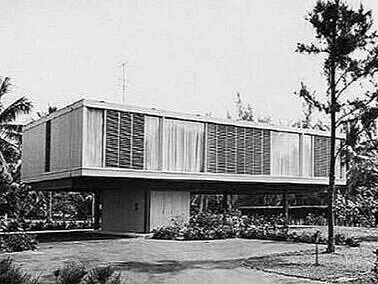
Paul Rudolph’s Biggs Residence in Delray Beach, Florida. Here it is shown in a 1956 photograph, in a prime, just-completed condition, as Rudolph had conceived it. But decades of changes by subsequent owners marred Rudolph’s design—and those included insensitively installed air conditioning equipment, and visually obtrusive additions. The intention: New owners and their architect declared that they wanted to “Bring it back to the way it should look..” and “Bring it back to the original layout and then assess what their next step will be.”
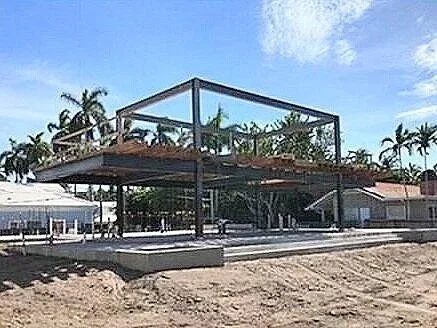
And what happened: Applying for a Certificate Of Appropriateness, they said: “The addition does not change or effect any of the distinctive features, finishes or construction techniques of the historic house. The house is being preserved and restored as originally designed by Paul Rudolph without any compromise arising out of the addition proposal, except for the connector at the rear, least public view.” In a report, commissioned by Delray Beach, the city’s consulting architect says: “In my professional opinion this is a false statement.”
Nina and Michael Marco were already committed to restoring a circa-1955 house in Delray Beach, Fla., when they struck home-renovation gold.
The day they closed on the property in 2018, the two were wandering through the house when they discovered a red velvet satchel in a bedroom closet. Inside, left undisturbed for decades, was a trove of black-and-white photographs and plans drawn by Paul Rudolph, the noted midcentury architect who designed the house. “It was a treasure chest,” Nina recalled.
The Marcos, who are real-estate developers, spent the next six years and some $7 million painstakingly reconstructing the residence, removing additions, repairing corroded steel and replacing rotten wood. Unlike prior renovations they have done, they plan to keep the home. “They’re going to carry me out of here,” Michael said.
To the Marcos, the project was a faithful reconstruction of an architectural icon. But a nonprofit dedicated to promoting Rudolph’s legacy says otherwise, raising questions about what, in fact, constitutes historic preservation. Their extensive rebuilding stripped the property of authenticity, according to the group, which says the Marcos demolished much of the home without a permit in 2020.
“The fact is, they destroyed a Paul Rudolph house,” said Kelvin Dickinson, CEO of the Paul Rudolph Institute for Modern Architecture.
A midcentury icon
Although Rudolph is best known for his Brutalist designs, the Delray Beach residence—built for art collector Sewell Biggs—was one of several Modernist homes he designed in Florida over a 20-year period, according to the book “Paul Rudolph: The Florida Houses.”
Spanning about 1,600 square feet, the Biggs house was rectilinear, with an exposed steel superstructure elevated on columns above an open-air ground floor. It had two bedrooms, a galley kitchen and large jalousie windows for ventilation. After Biggs sold the house, subsequent owners built additions in 1980 and 2007. In 2005, the house was listed on the Local Register of Historic Places.
When the Marcos purchased the house for about $1.4 million, it had been modified so much, and was so dilapidated, that “it did not look anything like the original,” Michael said.
The couple had previously renovated several other historic homes, and said they are selective about which projects they take on. “We hate all these modern, new homes in Florida,” said Nina, an interior designer.
In 2018, Delray Beach’s Historic Preservation Board approved their plans to remove two additions. A year later, the Marcos got permission to restore the historic house and construct a pool and their own addition with more bedrooms, linked to the historic house via a glass connector. Plans also called for enclosing the first floor of the original house in glass, using plans drawn by Rudolph. “It took some time to create the plan and do it the right way,” says Nina.
‘The actions are irreversible’
The Marcos’ plans took an unexpected turn, the couple said, when workers removed the additions and discovered that the home’s distinctive steel support beams were badly corroded. Until then, they hadn’t realized what bad shape the house was in, according to Michael. “We had no idea what we were getting ourselves into,” he said.
The flashpoint came on July 15, 2020, when workers removed old siding and windows. Within a few hours, the Biggs residence was a skeletal frame on four steel beams, with no structural walls to speak of.
The dramatic transformation took everyone by surprise—including the Marcos, according to Michael. Realizing the house needed substantial work, the couple in 2019 had submitted plans to the city for a new roof, wood siding and glass. Still, Michael said, “did I visualize ahead of time that within hours everything would be gone? No, I didn’t. And no one else did, either.”
Preservationists were outraged. Dickinson was in his office in New York when a neighbor sent him a picture of four columns sticking out of the ground. At first, he said, he didn’t even know what he was looking at.
Amid the outcry, the city issued a stop-work order. The Marcos were forced to appear at a February 2021 special magistrate hearing.
In a 17-page report, architect Richard Heisenbottle—hired by the city to advise it in the Marco case—said the couple’s work went “well beyond what was authorized” and that they demolished much more of the structure than their permit allowed.
“The actions are irreversible and irreparable,” testified Michelle Hoyland, the city’s preservation planner, according to news accounts.
In retrospect, Michael acknowledges that the couple went about things the wrong way. “We should have reviewed everything ahead of time to get the appropriate approvals—that was our mistake,” he said. At the same time, he and Nina were frustrated by the city’s opposition to their project, since officials hadn’t questioned the plan before approving it in 2019.
What is authentic, anyway?
What it means to save a historic building varies dramatically. There are generally four approaches, ranging from preservation, with repairs using original materials, to rehabilitation, then restoration and finally, reconstruction. The latter, which is what the Marcos did, relies on evidence to rebuild and replicate the original structure.
“We want to make sure these buildings can be restored and recognized for the importance that they have,” said Seri Worden of the National Trust for Historic Preservation. “But we also do want them to be inhabited and used.”
Still, critics of reconstruction say new structures can never be exact replicas, due to modern materials and zoning codes. The Marcos, for example, installed hurricane-proof windows in the Biggs residence. “I understand why they did what they did,” Dickinson said, but in his opinion, the move detracts from the home’s authenticity. “Paul Rudolph didn’t have hurricane glass in the 1950s.”
The Marcos say they were trying to stay true to the design while making the house livable. “We wanted to bring back the original designs, but in a sustainable way to be used for our family home,” Michael said.
Green light to rebuild
In December 2021, the Marcos returned to the preservation board seeking after-the-fact permission for demolition and reconstruction, which they received.
Over the next two years, they replicated tongue-and-groove siding and installed aluminum window louvers. They kept the exact dimensions of the original bedrooms, windows and living room.
But they moved the kitchen, which wasn’t up to code. “It was so narrow, you couldn’t open a cabinet and the refrigerator at the same time,” Michael said.
The kitchen is now located in the connector linking the original structure with the new addition. Nina said the addition, which isn’t visible from the street, is meant to “disappear” behind Rudolph’s design.
The Marcos moved into the house in 2024. It is a home for entertaining, Nina said, which is “exactly what Paul Rudolph intended it to be.”
Not everyone agrees. The Paul Rudolph Institute lists the Biggs Residence as “demolished” on its website.
Morris “Marty” Hylton III, president of the preservation nonprofit Architecture Sarasota, said he doesn’t consider the home historic. “It is essentially a new building,” he said. “Maybe they didn’t know what preserving a building meant,” he said, but it was a “radical decision” to remove everything from the house down to its steel framing. “It’s almost like, ‘Let’s ask for forgiveness rather than permission.’”
Another Rudolph nonprofit is somewhat more sympathetic to the Marcos’ work, however. “It is ideal? No,” said Sean Khorsandi, a board member of the Paul Rudolph Foundation. “Would we rather have it recreated rather than lost completely? Yes.”
The Marcos said they fundamentally disagree with preservation purists. “If it’s beautifully preserved but not built to code and not safe and nobody is living in it,” Nina says, “what’s the point?”
Go to the original article here.