
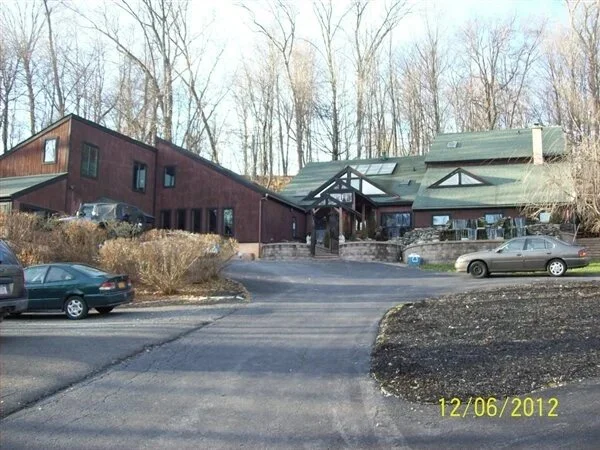
Photo from the Property Description Report from the Orange County, NY Municipal website

The property at 19 Greentree Lane in Chester, New York has been relisted for sale once again, and - once again - the marketing materials claim the home was designed by Paul Rudolph.
If this sounds familiar, it’s because it is.
In our earlier post from 2020, “What’s In A Name? When a ‘Rudolph’ Really Isn’t One,” we documented how this same property has appeared and disappeared from the market multiple times over the last decade, repeatedly returning with some version of the same attribution—despite the fact that the home is not included in Paul Rudolph’s project archives and no supporting documentation has been produced to substantiate the claim.
As we noted, third parties have also raised concerns about the attribution. USModernist reported that the home was advertised as a Rudolph design “based on a claim by the owner,” and that they found no evidence to support the claim—adding that the owner declined to provide documentation when asked.
This relisting is a useful reminder of a broader issue we encounter regularly: architects’ names are often used as marketing shorthand, and over time a description that merely evokes a designer’s work can harden into a definitive-sounding “designed by” claim—especially as listings are copied, rewritten, and reposted by new agents and outlets.
To be clear: we make no value judgment about the house itself. But when Paul Rudolph’s name is attached to a property, it matters—for scholarship, for preservation, and for buyers who may reasonably assume that such a claim is grounded in drawings, correspondence, photographs, or other primary-source evidence.
Our standing request
If the current owners or representatives of 19 Greentree Lane have documentation that demonstrates Paul Rudolph’s authorship or involvement, we would welcome the opportunity to review it and update our archives accordingly.
Until then, we encourage readers, journalists, and prospective buyers to treat the attribution with caution—and to remember the oldest rule in real estate (and in architectural history): buyer beware.
The following excerpt is taken from our original blog post in July 2020 about the property at 19 Greentree Lane:
When you represent the estate of an architect who has designed residential properties, you eventually receive word that they are going to be sold. At that point, in steps a real estate agent with the marketing vocabulary and poetic license to find a new owner.
As Christine Bartsch writes in her blog Writing Creative Real Estate Listing Descriptions: 3 Pro Tips (and a Warning!), “The better your listing description is, the better your chances are that buyers will come see your home in person. And the more showings you have, the higher your odds are to get multiple offers.”
It can sometimes be hard to find a new owner for a Rudolph-designed home. They can be of a certain age that they seem too small for today’s buyers (like the Cerritto Residence) or in a location that is no longer remote and in danger of being demolished for a bigger house (like the Walker Guest House) or they can be in a style that can make them hard to love (like the Micheels Residence).
In some cases the owners reach out to the Paul Rudolph Institute and we work with them to find a new owner who will preserve the property. We list these properties on our website with instructions here.
As we state in our mission statement, one of our goals is to help provide connections between sellers of Rudolph properties with preservation-minded buyers and design-sensitive real estate professionals. In order to ensure the properties are preserved, it is important they are owned and maintained.
So its interesting that - while its already challenging to preserve original Rudolph designs - we come across properties that claim they are Rudolph designs when there is no evidence that they are.
Note: The following homes are not included in Rudolph’s project list and we have no evidence (in either drawings, photographs or written communication) that they are Rudolph designs. We are happy to update our archives if the owners contact us and can provide supporting documentation.
19 Greentree Lane in Chester, New York
The 7,202 sqft home - which sold for $285,000 in 1995 and then $238,000 in 1999 - jumped 1,034% in price to $2,700,000 in 2014. According to public property records, the home was originally built in 1986 and last modified in 2000-2001. The additions include a 240 s.f. carport, 650 s.f. attached garage and 80 s.f. covered porch. No date is available when the heliport was added on the property.
The residence was listed and delisted several times since 2013 and marketing mentions Paul Rudolph although you might miss it based on the spelling:
“The Hudson Villa is named after its historic origin. Created by the renowned architect Paul Rudolf, the estate is a masterpiece of design and craftsmanship featuring a private white-sand beach and a resort-like setting less than an hour away from New York City.” - Hudson Valley Style Magazine, 07/09/2020
On its own website, the property description states:
“Designed by the renowned American architect Paul Rudolph, the home pays homage to the lodge tradition - precise craftsmanship is evident in architectural accents including cathedral ceilings, light-flooding skylights, and warm stone elements. Security and privacy are front of mind in the design, layout, and features of the property.”
We encourage you to visit the website and judge Rudolph’s participation for yourself based upon the pictures of the home’s interior.
Or, you can check this listing from the Off The Mrkt blog in September 2018:
Reality TV personality and mentor on Scared Straight and MAURY, Dave Vitalli, is selling an aspen style safe house in Chester, New York for $3,088,000.
This safe house located at 19 Greentree Lane was originally built by Paul Rudolph, a renowned architect, in 1986. Rudolph spared no expense when it came to making sure the house would withstand the threats of the world outside.
The safe house is built of thick slabs of concrete and reinforced steel to help maintain the structure just in case something were to happen. It also has generators, wells, and septic systems in place to allow for comfortable off the grid living. This property has also been previously used as a retreat for diplomats, celebrities, and dignitaries through the years.
The site includes a link to Rudolph’s wikipedia page, because they wouldn’t be able to find a link for the home in our project archives.
Its also interesting to note that the home’s location - Chester, NY - is located in Orange County. Orange County is best known for several Rudolph-related preservation controversies including the destruction of the John W. Chorley Elementary school in Middletown and the partial destruction and insensitive addition to the Orange County Government Center. Could the controversy and Rudolph’s name in the local paper have inspired the marketing connection?
The USModernist organization - which follows and promotes the preservation of modernist homes - says the house was “for sale 2014-2018, advertised as a Paul Rudolph design, based on a claim by the owner. We found no evidence to support that claim whatsoever, and the owner declined to produce any.”
USModernist contacted the property’s real estate agent in 2017, who could not produce any documentation but that Rudolph’s authorship is something ‘the family told them.’ The agent also said the owners commissioned Rudolph to do the renovation. However, they bought the house in 1999 after Paul Rudolph had passed away in 1997.
After speaking with us, USModernist informed the sales agent and asked that the record be corrected. Instead, the house was delisted only to return yet again as a Rudolph in several relistings with different agents ever since.
Rudolph comes up a few times in the history of this property - either ‘sparing no expense’ in 1986 or renovating the property in 1999 from the afterlife. We note with irony that the renamed ‘Hudson Villa’ is trademarked on the listing’s current website, while taking liberty with the mention of Rudolph’s involvement in the ‘trademark’ design.